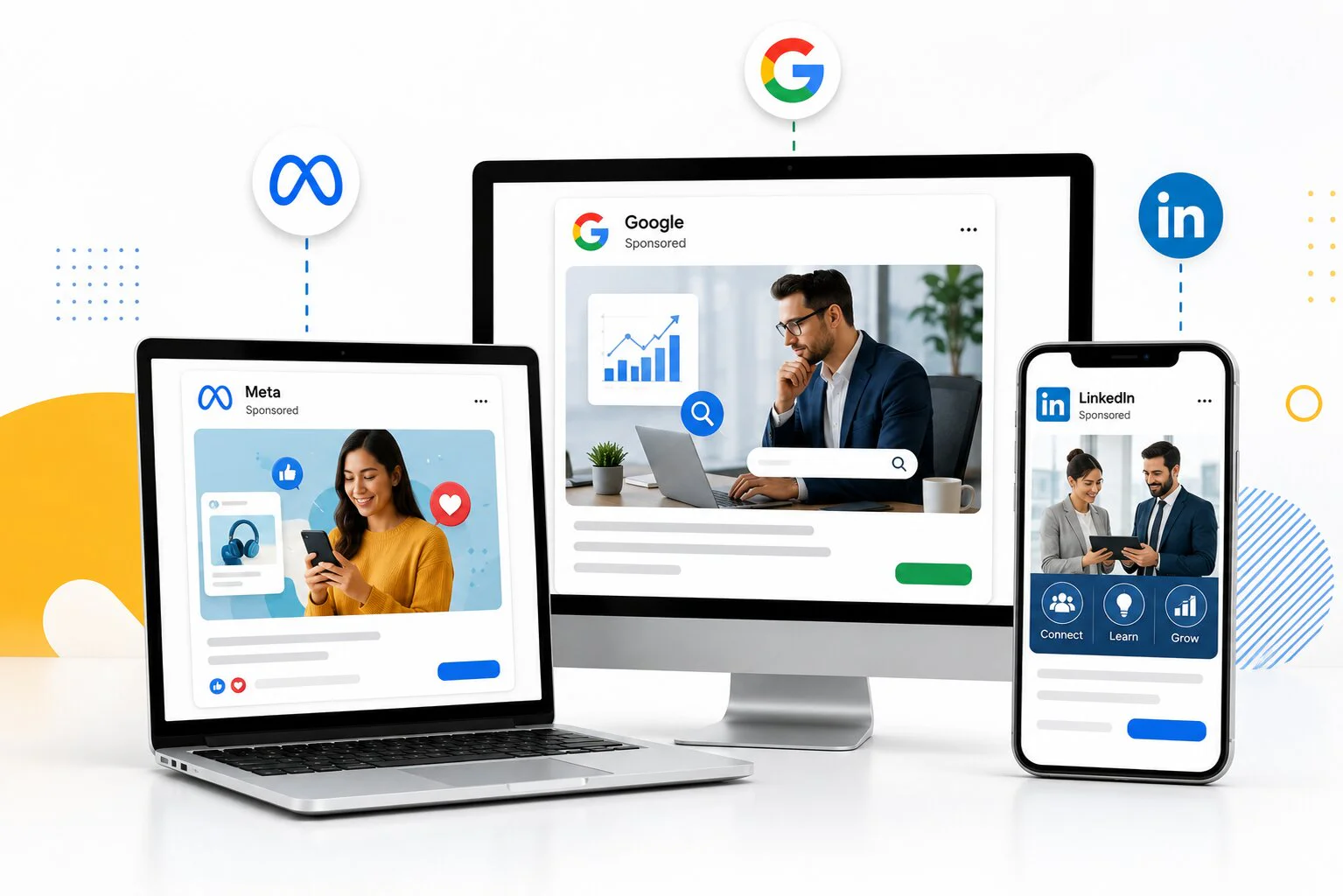
LinkedIn Ads vs Google Ads vs Facebook Ads: Which Platform Delivers the Best ROI for B2B Businesses?
For B2B businesses, running paid advertising campaigns is no longer just about increasing visibility. With rising competition and increasing advertising costs, companies need to ensure every marketing cost contributes toward measurable business growth.
The biggest challenge for marketers is deciding where to invest their budget.The comparison of LinkedIn Ads vs Google Ads vs Facebook Ads is not about finding a single platform that works for every business. Each advertising channel has unique strengths, challenges and use cases.
For B2B companies, the right choice depends on factors such as target audience, sales cycle, budget and revenue goals. A well-planned advertising strategy, supported by effective campaign management service, combines these platforms to improve campaign efficiency, reduce wasted spend and maximize return on investment (ROI).
This guide explores how LinkedIn Ads, Google Ads and Facebook Ads compare, their advantages and limitations, campaign types and how businesses can use them together to achieve better advertising performance.
Understanding ROI in B2B Advertising
Before comparing platforms, it is important to understand what makes an advertising campaign successful.
Clicks and impressions are useful indicators but they do not always represent business growth. A profitable B2B advertising strategy supported by professional campaign management solution focuses on metrics such as:
-
Return on Ad Spend (ROAS)
-
Customer Acquisition Cost (CAC)
-
Conversion rate
-
Cost per opportunity
-
Customer lifetime value
-
Revenue generated from campaigns
For example, a platform with cheaper clicks may not always deliver better results if those visitors do not become valuable customers. Similarly, a platform with higher CPC can provide better ROI if it reaches the right audience and generates high-value opportunities.
LinkedIn Ads for B2B Marketing
LinkedIn provides some of the strongest B2B audience targeting available. Businesses can build campaigns around professional roles rather than relying only on interests or search behaviour. The platform also places advertisements in a professional environment. Users are more likely to engage with industry insights, business research, webinars and case studies while browsing LinkedIn.
Lead quality is often higher because users provide accurate information about their employer, position and professional background. LinkedIn is particularly effective for promoting high-value resources such as whitepapers, reports, webinars and product demonstrations. These materials help marketers educate prospects during a complex buying process.
Strengths of LinkedIn Ads
LinkedIn provides some of the strongest B2B audience targeting available. Businesses can build campaigns around professional roles rather than relying only on interests or search behaviour.
The platform also places advertisements in a professional environment. Users are more likely to engage with industry insights, business research, webinars and case studies while browsing LinkedIn.
Lead quality is often higher because users provide accurate information about their employer, position and professional background. LinkedIn is particularly effective for promoting high-value resources such as whitepapers, reports, webinars and product demonstrations. These materials help marketers educate prospects during a complex buying process.
Limitations of LinkedIn Ads
The main disadvantage of LinkedIn is cost. Clicks and leads are often more expensive than on Facebook or Google Display campaigns.
The audience is also smaller than the audiences available through Google and Facebook. Highly specific targeting can reduce campaign reach even further.
LinkedIn advertising therefore requires careful audience selection and strong content. Broad campaigns with weak offers can consume a budget without producing enough qualified leads.
Google Ads for B2B Marketing
Google Ads helps businesses reach users based on search intent. This is its greatest advantage.
A prospect searching for enterprise software, IT consulting or industrial equipment is already expressing interest in a solution. Search ads allow B2B marketers to appear when that need becomes active.
Google also offers Display Ads, YouTube Ads and remarketing options. These formats allow advertisers to reach prospects beyond search results.
Within the debate around LinkedIn Ads vs. Google Ads vs. Facebook Ads Google is often the strongest platform for capturing bottom-of-the-funnel demand.
Strengths of Google Ads
Google Search Ads connect businesses with prospects who are actively researching products or services. This intent can produce strong conversion rates when campaigns target relevant commercial keywords.
The platform also provides broad reach. Advertisers can use search, display, video and shopping-related formats depending on their business model.
Remarketing allows companies to reconnect with users who visited their website but did not convert. This is valuable in B2B marketing because prospects often need several interactions before contacting a supplier.
Google also provides detailed keyword and conversion data. Marketers can analyse which searches generate leads and which campaigns contribute to revenue.
Limitations of Google Ads
Popular commercial keywords can become expensive due to high competition. Google also has limited professional targeting compared with LinkedIn.
Successful Google Ads campaigns require expertise in:
-
Keyword research
-
Bid optimization
-
Conversion tracking
-
Landing page improvement
which are important parts of effective Google Ads management services.
Facebook Ads for B2B Marketing
Facebook is often associated with consumer advertising. However, business owners and decision-makers also use the platform in their personal time.
Facebook Ads offer large audience reach and flexible targeting based on demographics, interests and online behaviour. Lookalike audiences can help advertisers find users who resemble existing customers or leads.
The platform can be particularly effective for awareness, content promotion and remarketing.
Facebook may not match LinkedIn’s professional targeting or Google’s search intent. Yet it can introduce a B2B brand to a broad audience at a lower cost.
Strengths of Facebook Ads
Facebook usually offers lower costs for impressions and clicks than LinkedIn. This makes it suitable for businesses that need to build awareness with a limited budget. Its visual formats work well for videos, customer stories, product demonstrations and educational content.
Facebook also provides strong retargeting capabilities. Businesses can show ads to people who visited a website, watched a video or engaged with previous content.
Lookalike audiences can expand campaign reach by identifying users with similar characteristics to existing customers.
Limitations of Facebook Ads
Facebook users are not usually searching for business solutions while browsing the platform. Their intent is generally lower than users clicking a Google Search Ad.
Professional targeting is also less precise than LinkedIn. Job-related data may be incomplete or outdated.This can lead to a higher volume of low-quality enquiries if the offer and audience are not carefully defined.
Facebook is generally more effective for creating awareness and nurturing interest than generating immediate high-value B2B conversions.
Best Campaign Types for B2B Businesses
LinkedIn Ads Campaigns
Sponsored Content - Promotes valuable content directly in users’ LinkedIn feeds.
Best for:
-
Brand building
-
Industry education
-
Content promotion
Message Ads - Allows businesses to send direct messages to targeted professionals.
Useful for:
-
ABM campaigns
-
Consultation offers
-
Event promotion
Lead Generation Forms - Allows users to submit information without leaving LinkedIn, improving campaign convenience.
Google Ads Campaigns
Search Ads - Best for capturing high-intent customers actively searching for solutions.
Display Ads - Useful for remarketing and maintaining brand visibility.
YouTube Ads - Helps educate audiences through engaging video content.
Facebook Ads Campaigns
Video Ads - Useful for product demonstrations, customer stories, and awareness campaigns.
Retargeting Ads - Helps bring back users who previously interacted with your website or content.
Lead Ads - Allows businesses to collect customer information directly inside Facebook.
Challenges That Impact Advertising ROI
LinkedIn Ads Challenges
-
High CPC
-
Limited audience size
-
Requires strong messaging
-
Needs precise targeting
Google Ads Challenges
-
Expensive competitive keywords
-
Requires ongoing optimization
-
Poor keyword selection can waste budget
Facebook Ads Challenges
-
Lower buying intent
-
Creative fatigue
-
Limited professional targeting
LinkedIn Ads vs. Google Ads vs. Facebook Ads by Buyer Intent
Buyer intent is one of the clearest ways to compare the three platforms.
Google generally provides the highest immediate intent because users are actively searching for information or solutions. While LinkedIn provides strong professional relevance. Users may not be searching for a supplier at that moment but they can be targeted based on their role and industry. Facebook usually provides lower direct intent. It is more effective for creating awareness and introducing a problem or solution.
A company seeking immediate enquiries may prioritise Google. A business targeting a narrow group of executives may prefer LinkedIn. A brand building recognition in a wider market may use Facebook.
Which Platform Delivers the Best Lead Quality?
LinkedIn often produces the highest-quality B2B leads because its targeting is based on professional data.
Google can also generate excellent leads when keywords reflect strong commercial intent. However, search campaigns may attract students, job seekers or consumers unless targeting and negative keywords are properly managed.
Facebook can produce affordable leads but quality may vary. Strong qualification questions and follow-up systems are often necessary.
Lead quality should always be measured against sales outcomes rather than form submissions alone.
Which Platform Is Most Cost-Effective?
Facebook is often the most affordable platform for impressions, clicks and top-of-the-funnel engagement.
Google can be cost-effective when campaigns target high-intent terms with strong conversion potential. Competitive keywords may increase costs but successful conversions can still generate strong returns.
LinkedIn generally has the highest cost per click and cost per lead. Yet its professional targeting may reduce wasted sales effort and improve opportunity quality.
The cheapest platform does not always produce the best ROI. The more important question is how much revenue each platform generates from the leads it delivers.
A Multi-Channel Strategy for Better B2B ROI
Many B2B businesses achieve stronger results by combining all three platforms.
Facebook can introduce the brand through educational videos and useful content. This builds an initial audience at a relatively low cost.
LinkedIn can then reach relevant decision-makers with webinars, reports and case studies. These campaigns help establish credibility and move prospects toward evaluation.
Google Search Ads can capture users when they begin actively searching for a provider. This supports bottom-of-the-funnel conversions.
Remarketing across Google and Facebook helps keep the brand visible throughout the sales cycle.
This approach allows each platform to perform the role it handles best and thus helping to find the best paid ads platform for B2B businesses.
Measuring Cross-Channel Performance
Unified reporting is essential when multiple platforms contribute to one customer journey. Marketers should track website visits, content downloads, booked consultations and sales opportunities. Conversion tracking should be implemented consistently across LinkedIn, Google and Facebook.
UTM parameters can help identify which campaigns generated traffic and leads. CRM data can connect those leads to pipeline value and closed revenue. Marketers should also examine assisted conversions. A buyer may discover the company on Facebook, engage with a LinkedIn ad and later convert through Google Search.
Conclusion
The debate around LinkedIn Ads vs Google Ads vs Facebook Ads does not have a single winner. Each platform delivers value in different ways.
LinkedIn Ads are ideal for reaching professional audiences and decision-makers. Google Ads performs strongly when customers are actively searching for solutions. Facebook Ads helps businesses expand their reach, improve awareness and support remarketing efforts.
The most effective B2B advertising strategy combines all three platforms based on their strengths. However, achieving consistent ROI requires proper planning, campaign optimization and continuous performance monitoring. Partnering with an experienced digital marketing team can help businesses create data-driven campaigns, improve customer acquisition and maximize advertising investments across LinkedIn, Google, and Facebook.
Idiosys Tech helps businesses improve their digital presence through strategic campaign management service, including paid advertising, SEO and performance-focused campaigns designed to generate measurable growth.
-------------------------------------------------------------------------------------------------------
1. Which platform provides the best ROI for B2B advertising?
Google Ads often delivers faster ROI because it captures active search demand, while LinkedIn can provide higher-value returns for businesses targeting specific decision-makers.
2. Are LinkedIn Ads expensive compared to Google and Facebook?
Yes, LinkedIn usually has higher CPCs but the quality of professional targeting can justify the cost for high-value B2B services.
3. Can Facebook Ads improve B2B advertising performance?
Yes. Facebook Ads can support B2B campaigns through awareness, audience expansion and remarketing.
4. Should B2B companies use all three platforms?
A multi-channel approach is often the most effective because LinkedIn, Google and Facebook support different stages of the buyer journey and help maximize overall ROI.
--------------------------------------------------------------------------------------
You May Also Read
12 Digital Marketing Mistakes That Quietly Waste Your SEO and Advertising Budget
Kritika Bose
Digital Marketer, Idiosys Tech
Specializing in SEO, social media and content, she helps brand strengthen their online presence through search-focused content, creative communication and digital trends that drive visibility, engagement and sustainable growth.