
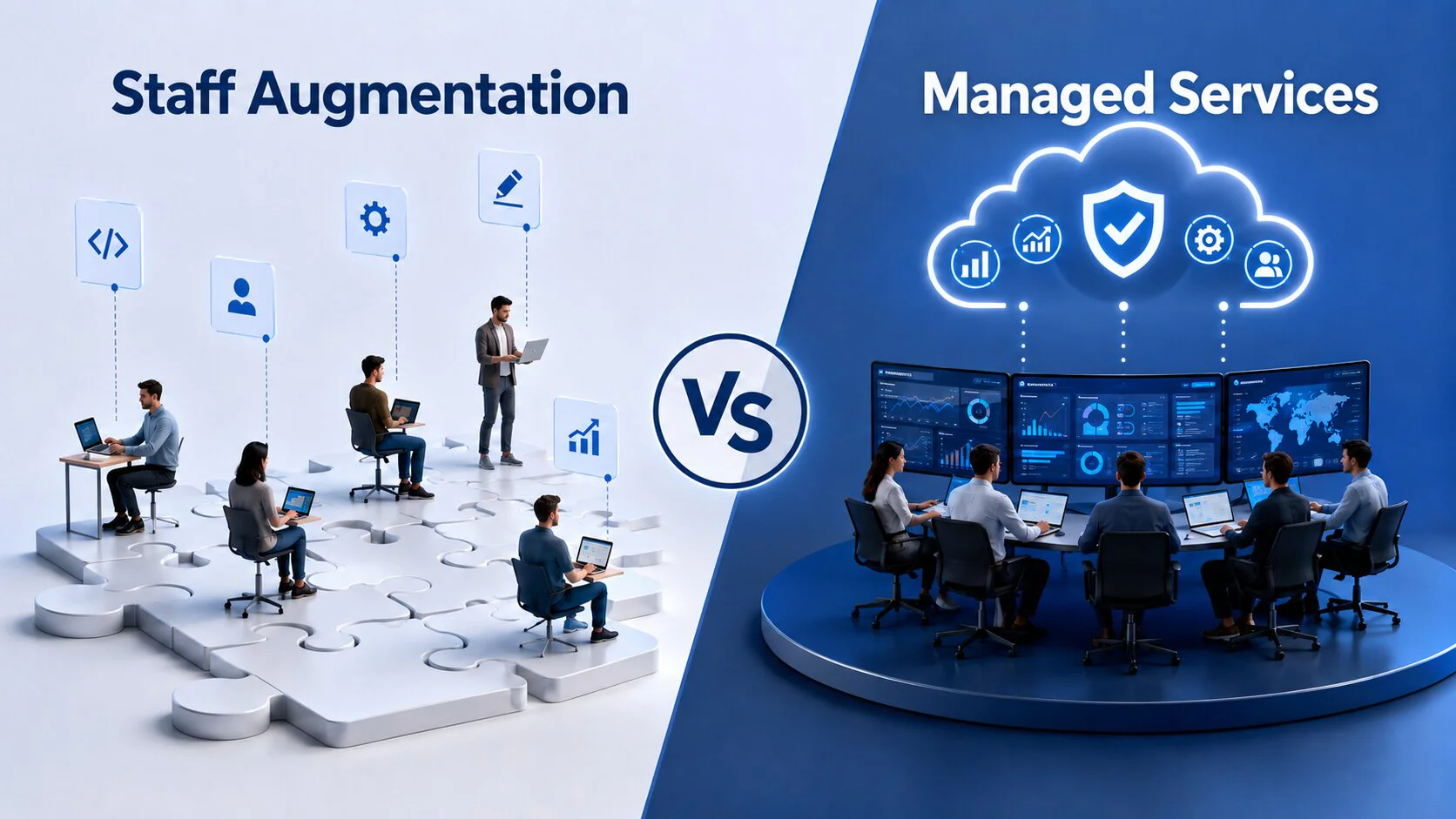
Staff Augmentation vs Managed Services: Which Model Is Right for Your Project?
Businesses need professionals to complete projects faster and respond to changing customer expectations. Building a permanent internal team for every technical requirement can be expensive and slow. Remote work has made it easier to access specialists from different locations.
Staff augmentation and managed services are two outsourcing models. Both can fill skill gaps and improve delivery. However they differ in control and responsibility.
The staff augmentation vs managed services decision should be based on your resources and project scope and expected duration. You should also consider how much control you want to retain and how much responsibility you want to transfer.
What Is Staff Augmentation?
Staff augmentation models allow a business to temporarily add external professionals to its existing team. Through staff augmentation services companies can access skilled specialists who work alongside internal employees and follow existing tools and workflows.
The client remains responsible for management. Internal leaders assign tasks and review work and set priorities. The external professionals add skills and capacity while the client remains accountable for delivery.
This model is widely used in software development. A company may hire developers or designers when its internal team lacks capacity. It may also bring in DevOps or cloud specialists for a particular project stage.
What Are Managed Services?
Managed services involve outsourcing a complete project or technical function to an external provider. The provider creates and manages the team and takes responsibility for delivering the agreed outcome.
The client defines the goals and expected results. The provider handles planning and execution and quality control. Communication normally takes place through a project manager.
Managed services can support software development and cloud infrastructure and maintenance. They can also cover data migration and technical support and cybersecurity monitoring.
Staff Augmentation vs Managed Services: Main Differences
The biggest difference is responsibility. Staff augmentation gives a company additional professionals. The company manages them and remains responsible for delivery.
Managed services give the company an agreed service or result. The provider manages the team and accepts responsibility for completing the work.
Augmented professionals usually collaborate directly with internal employees. A managed services team generally provides updates through scheduled meetings and reports.
Staff augmentation is often billed through hourly or monthly resource rates. Managed services may use fixed pricing or retainers or milestone-based payments.
Benefits of Staff Augmentation
Staff augmentation offers flexibility. A company can expand its team when workloads rise and reduce it after the project is completed. This helps avoid permanent hiring for temporary needs.
It also provides access to specialised expertise. A company can select professionals according to technology and industry knowledge and experience.
Another benefit is control. The client manages external professionals directly and can change priorities when requirements evolve.
A provider can also supply pre-screened specialists faster than traditional hiring.
Professional IT staff augmentation services allow businesses to access developers and designers and QA engineers with the skills required for specific project stages.
Limitations of Staff Augmentation
Staff augmentation still requires internal management. The client must assign tasks and monitor performance and resolve problems.
External specialists also need on-boarding. They must understand the product and technical standards and internal processes.
The model may not be ideal for a permanent requirement. Long engagements can sometimes make permanent hiring or managed services more cost-effective.
Benefits of Managed Services
Managed services reduce daily internal supervision. The provider manages the team and delivery process. This allows the client to focus on customers and business growth.
A provider can offer a complete team that includes developers and designers and testers and project managers.
The provider also handles project planning and quality control. If a team member leaves then the provider normally arranges a replacement.
Limitations of Managed Services
Managed services provide less control over daily work. The provider manages operational decisions. This may not suit a company that wants to supervise every technical detail.
A detailed project brief is essential. Unclear requirements may lead to additional costs and scope changes and delays.
The client may communicate mainly with one project manager.
Managed services can also have a higher initial cost because the price may include management and quality assurance.
Cost Comparison
Staff augmentation costs are usually based on the number of professionals and the engagement period. Rates vary according to skill level and location and experience.
This model can be cost-effective when the company already has project managers and development processes. However the cost of internal supervision should also be considered.
Managed services may use a fixed fee or retainer or milestone agreement. The price can cover the complete team and project management and testing and reporting.
Compare the total delivery cost rather than only the hourly rate.
Flexibility and Scalability
Staff augmentation usually offers greater flexibility when a company needs to change team size. It can add specialists during a busy phase and reduce the team later.
Managed services can also scale. However major changes may require a revised scope and budget and timeline.
Staff augmentation often suits changing requirements. Managed services may be stronger when the expected outcome is clearly defined.
Project Control and Communication
Staff augmentation provides more direct control. The client decides what each professional works on and how tasks are prioritised.
Managed services focus more on results. The client agrees on deliverables and deadlines and service expectations. The provider controls daily execution.
Security and Intellectual Property
Security matters under both models. External professionals may need access to source code and internal systems and customer information.
Staff augmentation allows the client to control individual access. Non-disclosure agreements and role-based permissions can help protect sensitive information.
Managed services may require broader access. The client should review the provider’s security policies and data protection processes.
The contract should confirm who owns the source code and designs and documents after project completion.
Project Duration
Staff augmentation often suits short-term or medium-term projects such as product launches and seasonal workloads and temporary skill shortages.
Managed services may suit complete projects and long-term technical operations such as application maintenance and infrastructure management.
Which Model Should You Choose?
Choose staff augmentation when you already have a capable internal team and need additional specialists. It is also suitable when you want direct control over tasks and technical decisions.
Choose managed services when you want to outsource a complete project or ongoing function. It is useful when internal management capacity is limited.
Before deciding, review your scope and timeline and budget and security requirements. Determine whether you need individual specialists or a complete delivery team.
Can Both Models Be Combined?
A company can combine both models. It may add developers to its product team while outsourcing cloud management or cybersecurity to a managed services provider.
This hybrid approach can provide flexibility and specialist support. Responsibilities must be clearly documented to prevent duplicated work and communication problems.
Conclusion
The staff augmentation vs managed services decision depends on your internal capabilities and project requirements and preferred level of control.
Staff augmentation is ideal when you need skilled professionals to strengthen an existing team. It offers flexibility and direct communication and specialised expertise. However the client must manage the professionals and remain responsible for delivery.
Managed services are suitable when you want an external provider to manage a complete project or technical function. They reduce daily supervision and provide access to a complete team. However the scope must be clear and the provider must be reliable.
When comparing staff augmentation vs managed services you should consider more than cost. Review project duration and management capacity and security requirements and expected outcomes.
Idiosys Tech can help you build a flexible development team through professional staff augmentation services. Whether you need one developer or a dedicated team our specialists can provide the technical expertise and scalable support required to keep your project moving.
-------------------------------------------------------------------------------------------------------
What is staff augmentation?
Staff augmentation is an outsourcing model where external professionals temporarily join an existing team. The client manages their tasks and remains responsible for delivery.
What are managed services?
Managed services involve outsourcing a complete project or technical function to an external provider. The provider manages the team and deliverables.
What is the main difference between the two models?
Staff augmentation provides professionals managed by the client. Managed services provide a complete service or team managed by the provider.
When should a company choose staff augmentation?
It suits companies that already have an internal team and project manager but need specific skills or extra capacity.
When should a company choose managed services?
It suits companies that want to outsource a complete project or ongoing function and have limited internal management capacity.
Which model is more cost-effective?
Staff augmentation may cost less when only a few specialists are required. Managed services may offer better value when a complete team and project management are needed.
-------------------------------------------------------------------------------------------------------
You May Also Read
Staff Augmentation vs. In-House Hiring: Which is Better for Your Business?
Idiosys Tech
Editorial Team, Idiosys Tech
Part of the Idiosys Tech team, working with clients across healthcare, eCommerce, and enterprise software to deliver solutions that scale.