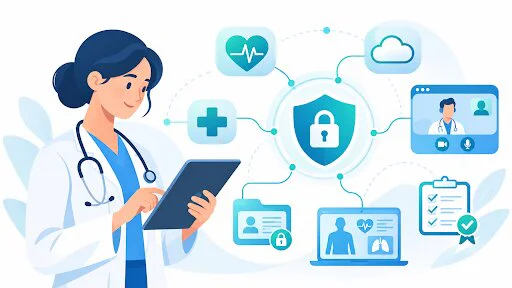
Building a healthcare SaaS platform is fundamentally different from launching conventional business software. A scheduling error can leave a patient without an assigned caregiver. An incorrect access permission can expose confidential medical information. A failed integration can prevent clinicians from accessing essential patient records.
For HealthTech founders and healthcare technology leaders these are not simply software defects. They represent operational risks that can affect patient care and regulatory compliance.
Successful healthcare SaaS development requires an architecture that connects clinical workflows with secure data management and dependable infrastructure. Whether the platform serves hospitals or domiciliary care agencies or telemedicine providers it must accommodate different user roles without compromising information security.
The challenge becomes more complex when multiple healthcare organizations share the same software infrastructure.
How can a platform protect patient information while supporting hundreds of care teams? How should developers handle clinical integrations and audit records as adoption increases?
Understanding these engineering decisions early helps digital health companies avoid expensive redesigns and build software that can support sustainable growth.
Why Healthcare SaaS Development Requires a Different Engineering Approach
Healthcare SaaS platforms must support two systems simultaneously: the technology infrastructure and the healthcare operation using it.
A conventional workforce application might record employee attendance. A domiciliary care platform must additionally connect attendance with a scheduled patient visit and care documentation.
If a caregiver misses an appointment the system may need to alert a coordinator and preserve an accurate record of what happened.
This creates four critical engineering requirements.
Clinical and Operational Accuracy
Healthcare applications must preserve accurate records across interconnected workflows.
A cancelled care visit should update the relevant schedule and administrative records without accidentally deleting clinical documentation.
Patient Data Protection
Access must reflect clinical responsibilities and organizational boundaries.
A care coordinator may require scheduling information without access to every clinical detail. A visiting caregiver should generally see only information necessary for assigned care responsibilities.
Traceable System Activity
Healthcare organizations need defensible records of important actions including access to sensitive information and changes to care documentation.
Audit records should identify the actor and action alongside the time and affected resource.
Reliable Service Delivery
Care providers cannot depend on a platform that becomes inaccessible during busy operational periods.
Applications should account for connectivity interruptions and recovery procedures alongside infrastructure failures.
These requirements make healthcare software architecture a foundational business decision rather than a technical detail addressed after launch.
Multi Tenant Healthcare SaaS Architecture: How Should Patient Data Be Separated?
Multi tenant architecture allows different healthcare organizations to operate through a common application while maintaining separate data and configurations.
Consider a platform serving 80 domiciliary care agencies.
Each agency requires its own staff directory and patient records alongside schedules and compliance reports. Administrators from one agency must never access another agency's information.
The challenge is maintaining these boundaries across every system component.
Three Tenant Isolation Models
Model
Suitable scenario
Engineering tradeoff
Shared database with tenant identifiers
Smaller organizations with standardized requirements
Efficient infrastructure but greater reliance on rigorous isolation controls
For a shared database architecture developers can enforce tenant boundaries through database access policies and application authorization.
Automated tests should attempt unauthorized access between tenants before production releases.
A Critical Design Principle
Tenant isolation must apply to background jobs and search indexes alongside APIs and databases.
A platform may protect its main patient records correctly while accidentally exposing another organization's information through a reporting export or cached search result.
Testing must cover these secondary data paths rather than focusing exclusively on the main application interface.
What Modules Should a Healthcare SaaS Platform Include?
A successful digital health SaaS platform should reflect its intended care delivery model.
Building every possible healthcare feature during the initial release increases costs without necessarily improving the product.
For care management software the highest priority modules often differ from those of an EHR product or a telemedicine application.
Care Planning and Patient Records
Care teams need access to relevant patient profiles and care instructions alongside assessment histories.
The system should maintain document versions and record important changes so that authorized staff can understand how care requirements evolve.
Staff Scheduling and Visit Verification
Care organizations need to coordinate shifts and caregiver availability across locations.
Attendance verification may use NFC or GPS technologies where appropriate. However location data should not be treated as proof that every required care activity occurred.
Electronic Health Records
Products supporting clinical documentation may require medication histories and allergies alongside diagnoses and treatment records.
EHR functionality should follow clinical data requirements and integration specifications rather than simply storing unstructured notes.
Telemedicine and Appointment Management
Virtual care platforms may include practitioner availability and video consultations alongside patient consent and electronic prescriptions where permitted.
Consultation records should remain connected to the appropriate patient identity.
Billing and Compliance Reporting
Billing workflows should reconcile documented services with authorized charges.
Audit reports should provide trustworthy evidence of relevant operational activities without granting unnecessary access to patient data.
The strongest product scope is determined by actual care workflows rather than the number of available modules.
How HIPAA, HL7 and FHIR Affect Healthcare SaaS Development
Healthcare SaaS compliance is not a feature that can be activated before product launch.
Regulatory requirements influence architecture decisions and organizational processes throughout development.
HIPAA and Protected Health Information
For applicable US healthcare organizations HIPAA establishes requirements for protecting health information.
The Security Rule requires administrative and physical safeguards alongside technical safeguards for electronic protected health information.
An appropriate security design may include access controls and encryption alongside audit mechanisms and recovery procedures.
Organizations must also consider contractual responsibilities. Where a cloud provider handles regulated information on behalf of a covered entity or business associate an appropriate Business Associate Agreement may be required.
The US Department of Health and Human Services emphasizes that using cloud infrastructure does not remove the organization's responsibility to manage security risks.
HL7 and Healthcare Interoperability
HL7 provides standards that support information exchange between healthcare systems.
Existing hospital applications may use different HL7 messaging approaches or proprietary interfaces.
Integration planning must identify what each system actually supports before selecting an exchange method.
FHIR and Structured Clinical Data
FHIR provides standardized resources and interfaces for exchanging healthcare information.
Resources such as Patient and Observation can represent defined clinical information.
However supporting FHIR does not mean every healthcare system can automatically exchange information correctly.
Teams must still validate supported versions and implementation guides alongside terminology mappings and authorization requirements.
For international healthcare products additional privacy requirements should be evaluated according to the markets being served.
A Compliance Ready Healthcare SaaS Technology Stack
A healthcare SaaS platform needs technology that supports maintainable software and appropriate security controls.
Layer
Technology options
Important considerations
User interface
React or Next.js
Accessible clinician and patient workflows
Backend services
Node.js or Python
Secure clinical business logic
Database
PostgreSQL
Structured records and tenant isolation
API integration
REST APIs and FHIR
Validated clinical data exchange
Cloud infrastructure
AWS or Azure
Configured security and recovery controls
Identity management
OpenID Connect and OAuth 2.0
Authentication and authorized access
Monitoring
Centralized logging and observability
Incident detection and operational visibility
The technology choices should follow the product's risk assessment.
For example deploying a healthcare application on AWS does not automatically make it HIPAA compliant. The organization must configure appropriate safeguards and meet applicable contractual and operational obligations.
A well engineered application also needs security testing and controlled deployments alongside documented incident response procedures.
Five Healthcare SaaS Architecture Mistakes That Become Expensive at Scale
Healthcare technology teams should identify potential failure patterns before onboarding enterprise customers.
1. Treating Tenant Identifiers as Sufficient Security
Adding an organization ID to database records is insufficient when authorization checks can be bypassed.
Enforce tenant boundaries across all services and test unauthorized access scenarios.
2. Designing Integrations After Product Development
A proprietary patient data model may require costly rework when hospitals demand interoperability.
Assess external system requirements before finalizing the internal clinical data model.
3. Mixing Audit Records With Ordinary Application Logs
Operational logs may be rotated or modified for troubleshooting.
Security audit records require defined integrity controls and retention policies appropriate to their purpose.
4. Ignoring Mobile Connectivity Limitations
Community caregivers may work in areas with unreliable connectivity.
Where offline functionality is necessary the application should support protected local storage and controlled synchronization with conflict resolution.
5. Scaling Infrastructure Without Testing Clinical Workflows
Higher server capacity does not resolve inefficient scheduling logic or slow patient record queries.
Performance tests should represent realistic healthcare activities and concurrent users.
These mistakes demonstrate why scalability must include data integrity and workflow reliability alongside infrastructure capacity.
How Idiosys Tech Connects Healthcare Operations With Scalable Software Engineering
Healthcare organizations need more than technically functional applications. They need software that reflects how care is delivered and documented across different teams.
Idiosys Tech has documented experience developing domiciliary care management systems involving staff scheduling and attendance verification alongside care administration and reporting.
Its healthcare solutions portfolio addresses workflows for care agencies and care home groups alongside community healthcare organizations.
For teams evaluating custom healthcare software solutions this industry experience provides a relevant starting point for discussing operational requirements.
A Practical Healthcare Engineering Approach
A healthcare platform assessment should examine three connected areas.
Clinical and operational workflows: Understand how care is assigned and delivered alongside how completion is recorded.
Data architecture and access control: Establish organizational boundaries and permissions before expanding application functionality.
Integration and scalability requirements: Evaluate existing systems and expected transaction volumes alongside deployment and monitoring needs.
For example a multi agency care platform must handle separate staff schedules while allowing appropriately authorized central administrators to view operational performance.
The goal is a healthcare platform that supports real care delivery and remains maintainable as the organization expands.
Healthcare SaaS Development Checklist Before Product Launch
Healthcare founders and CTOs can use the following checklist during architecture reviews.
Assessment area
Question to validate
Patient information
Is sensitive data accessed only by authorized users?
Tenant isolation
Can users retrieve information belonging to another organization?
Auditability
Can important record changes be traced reliably?
Interoperability
Have external systems and supported standards been verified?
Infrastructure
Have recovery procedures and capacity limits been tested?
Clinical usability
Have actual care teams validated important workflows?
Data governance
Are retention and export responsibilities clearly defined?
A successful assessment should produce documented decisions and test evidence rather than a simple statement that the software is secure.
Conclusion
Healthcare SaaS development requires more than secure cloud hosting and a collection of clinical features. Successful platforms must reflect real healthcare workflows while protecting patient information and supporting dependable service delivery.
The strongest architecture decisions begin with understanding how healthcare organizations operate. Tenant isolation and interoperability planning alongside auditability and recovery testing should be established before rapid expansion introduces additional complexity.
For HealthTech founders this reduces the risk of rebuilding essential infrastructure. For healthcare technology leaders it creates a clearer basis for evaluating software reliability and long term maintainability.
Idiosys Tech brings healthcare workflow experience and software engineering capabilities to these challenges. Organizations planning a new platform or modernizing existing care management systems can explore its healthcare software development expertise to discuss architecture and implementation requirements.
Frequently Asked Questions
What is healthcare SaaS development?
Healthcare SaaS development involves building cloud delivered applications for clinical or healthcare administration workflows. These products may support care management and patient records alongside scheduling and telemedicine.
How is healthcare SaaS different from traditional SaaS?
Healthcare SaaS often requires more extensive patient data protection and traceability alongside clinical interoperability and operational continuity.
Can healthcare SaaS platforms support multiple organizations?
Yes. Multi tenant architecture can support multiple organizations when appropriate data isolation and authorization controls are designed and tested.
Is FHIR mandatory for every healthcare SaaS platform?
No. FHIR requirements depend on the product's market and integration obligations alongside applicable regulations and customer expectations.
How much does healthcare SaaS development cost?
Costs depend on product scope and integration complexity alongside security requirements and infrastructure needs. A defensible estimate requires discovery and architecture assessment.
How can healthcare SaaS platforms prepare for enterprise adoption?
Teams should document security controls and validate tenant isolation alongside recovery procedures and integration capabilities before expanding to enterprise customers.
Share:
S
Shreya Roy
Junior Full Stack Web Developer, Idiosys Tech
A Junior Full Stack Web Developer with 1.5+ years of experience, builds responsive and user-friendly websites. Skilled in both front-end and back-end technologies, she is passionate about creating efficient and scalable digital solutions.