Hybrid App Development in 2026: Is It Still Worth It Compared to Native and Cross-Platform?
In 2026, businesses are under pressure to launch faster, optimize costs and deliver seamless user experiences across multiple devices. Whether you are building a customer-facing app, an enterprise solution or a startup MVP, the development approach you choose directly impacts your budget, scalability, maintenance and long-term success.Today, businesses have three primary options: native development, hybrid app development and cross-platform development. While native apps have long been known for their performance, modern hybrid and cross-platform frameworks have evolved significantly, offering faster development cycles and lower costs without compromising quality for most business applications.
Understanding Hybrid App Development
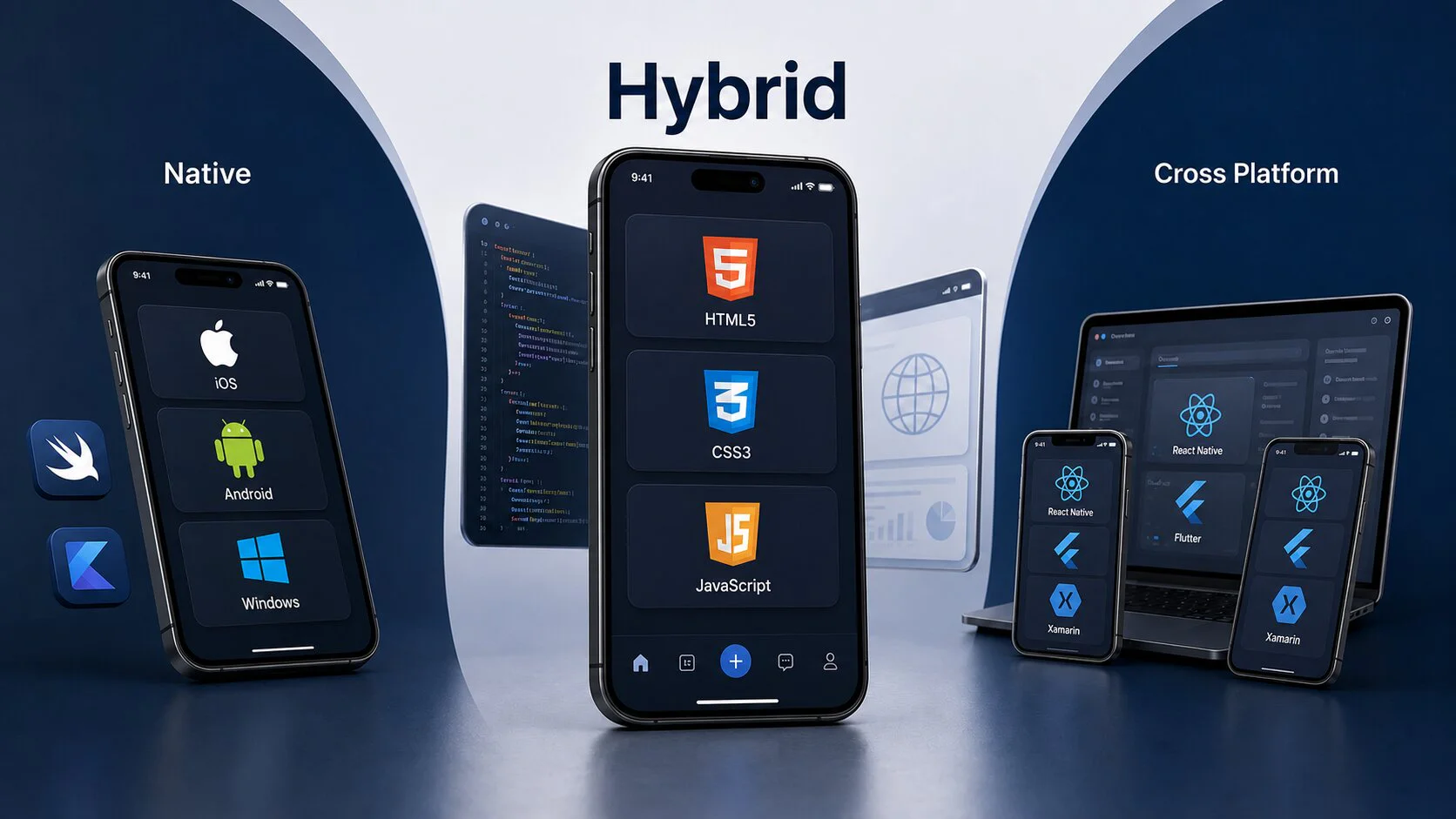
Hybrid applications combine web technologies such as HTML, CSS and JavaScript with a native wrapper, allowing a single application to run across multiple operating systems.
Traditional hybrid apps are often built using frameworks like Ionic or Cordova and are particularly effective for applications that do not rely heavily on advanced device capabilities.
Hybrid app development is commonly used for:
-
Business management applications
-
Customer portals
-
Internal enterprise tools
-
Event applications
-
Simple eCommerce platforms
Its biggest advantage is cost efficiency. Since developers work with a single codebase, businesses can significantly reduce development time, maintenance efforts and overall project costs.
Understanding Native App Development
Native applications are developed specifically for a single operating system using platform-specific programming languages.
For example:
-
iOS apps are developed using Swift or Objective-C.
-
Android apps are developed using Kotlin or Java.
Since native apps are built exclusively for one platform, they provide direct access to device hardware and operating system features, making them ideal for applications requiring exceptional speed and performance.
Native development is best suited for:
-
High-performance gaming applications
-
AR and VR experiences
-
Financial and security-focused apps
-
Complex real-time processing
-
Applications requiring extensive hardware access
However, native development comes with higher development costs, separate codebases for Android and iOS and longer maintenance cycles.
Understanding Cross-Platform App Development
Cross-platform development has become one of the most popular approaches in recent years. Unlike traditional hybrid apps, modern cross-platform frameworks compile applications into native components, delivering a more responsive and native-like experience.
Popular frameworks include:
-
Flutter
-
React Native
-
.NET MAUI
Cross-platform development offers an excellent balance between development speed, performance and scalability.
It is well suited for:
-
Healthcare applications
-
FinTech solutions
-
SaaS products
-
On-demand service apps
-
Enterprise mobility solutions
-
Large-scale eCommerce platforms
For many businesses, cross-platform development has become the preferred alternative to native development because it reduces costs while delivering high-quality user experiences.
Cost Comparison
Budget plays a major role in selecting a development approach.
Hybrid Development
Hybrid development uses one codebase for multiple platforms, reducing:
-
Development costs
-
Testing efforts
-
Maintenance expenses
-
Resource requirements
It is often the most affordable choice for startups and small businesses.
Native Development
Native development requires:
-
Separate Android and iOS teams
-
Independent testing processes
-
Two codebases
-
Higher long-term maintenance costs
While it delivers outstanding performance, it is also the most expensive option.
Cross-Platform Development
Cross-platform development also uses a shared codebase but offers better performance than traditional hybrid apps.
For many businesses, it delivers the best balance between cost and quality.
Speed to Market: Which Approach Is Faster?
Launching quickly allows businesses to validate ideas, gain customers and stay ahead of competitors.
Hybrid Development
Hybrid development accelerates delivery by allowing developers to write code once and deploy it across platforms.
Native Development
Since Android and iOS applications are developed separately, timelines are generally longer.
Cross-Platform Development
Cross-platform frameworks further improve development speed with reusable UI components, hot reload capabilities and streamlined testing.
For businesses prioritizing rapid deployment, hybrid and cross-platform approaches provide a significant advantage.
Performance: Native Still Leads but the Gap Is Narrowing
Performance has long been the biggest differentiator between development approaches.
Hybrid Development
Traditional hybrid apps have improved considerably over the years and now perform well for most business applications. However, they may still experience limitations in graphics-intensive or hardware-dependent scenarios.
Native Development
Native apps offer:
-
Maximum speed
-
Smooth animations
-
Direct hardware access
-
Superior graphics rendering
This makes them ideal for performance-intensive applications.
Cross-Platform Development
Modern frameworks such as Flutter and React Native deliver near-native performance for most commercial applications, making them suitable for industries ranging from healthcare to retail.
Unless your application requires advanced gaming or AR/VR capabilities, cross-platform performance is often more than sufficient.
User Experience: Delivering Consistency Across Platforms
User experience plays a critical role in customer retention.
Native applications naturally follow platform-specific design guidelines, creating highly polished experiences.
Hybrid applications offer consistent interfaces across devices, making them ideal for businesses seeking uniform branding.
Cross-platform frameworks combine consistent design with responsive performance, allowing developers to create visually appealing applications that feel native on both Android and iOS.
Maintenance and Updates
Maintaining two native applications means managing separate updates, testing cycles and feature releases.
Hybrid and cross-platform development simplify maintenance by using a shared codebase.
Benefits include:
-
Faster updates
-
Easier bug fixes
-
Lower maintenance costs
-
Consistent feature deployment
For businesses planning continuous improvements, shared-codebase development offers significant long-term advantages.
Scalability: Preparing for Future Growth
Applications should support future expansion without requiring major redevelopment.
Native applications offer excellent scalability but often require additional development resources.
Hybrid applications can scale effectively when built using modular architecture and cloud-based infrastructure.
Cross-platform applications combine scalability with flexibility, making them suitable for businesses expecting rapid growth.
Integrations and Plugin Support
Modern applications frequently integrate with:
-
Payment gateways
-
CRM platforms
-
ERP systems
-
Marketing automation software
-
Cloud storage solutions
-
Analytics platforms
Native applications provide the deepest integration with operating systems.
Cross-platform frameworks offer extensive plugin ecosystems that support most business requirements.
Hybrid applications also support many third-party integrations, though complex hardware interactions may require additional customization.
Ideal for Startups and High-Growth Companies
Startups need to validate ideas quickly while managing limited budgets.
Hybrid development offers:
-
Lower upfront investment
-
Faster MVP development
-
Simple maintenance
-
Quick deployment
Cross-platform development provides similar advantages while delivering stronger performance, making it a preferred option for many growing businesses.
Native development is generally recommended when performance requirements justify the additional investment.
Security Considerations
Security remains a priority regardless of the development approach.
Native applications benefit from direct access to operating system security features.
Hybrid and cross-platform applications can also provide strong protection through:
-
End-to-end encryption
-
Secure API communication
-
Multi-factor authentication
-
Code obfuscation
-
Regular security updates
When implemented using industry best practices, all three approaches can meet modern business security requirements.
Hybrid Adoption Is Increasing Rapidly in 2026
Mobile app development continues to evolve, with businesses placing greater emphasis on flexibility, faster deployment, and cost efficiency.
Traditional hybrid development remains a practical choice for lightweight business applications and internal tools where rapid delivery and affordability are key priorities.
At the same time, cross-platform frameworks such as Flutter and React Native have become the preferred option for many commercial applications because they offer near-native performance with a shared codebase.
Native development continues to dominate industries that require advanced graphics, real-time processing, or extensive hardware integration, but for many organizations, hybrid and cross-platform solutions provide a more balanced approach.
Final Verdict: Which Should You Choose in 2026?
There is no one-size-fits-all solution. The right approach depends on your business objectives, budget, timeline, and technical requirements.
Choose hybrid development if your priority is affordability, faster deployment, and maintaining a single codebase for lightweight business applications or MVPs.
Choose native development if your application requires maximum performance, advanced graphics, or deep hardware integration.
Choose cross-platform development if you want an optimal balance of performance, scalability, cost efficiency, and faster time to market. For many businesses in 2026, this approach delivers the best overall value.
Whether you're launching a new product or modernizing an existing application, partnering with an experienced development team ensures your app is built using the approach that best supports your long-term goals.
Develop Future-Ready Mobile Apps with Idiosys Tech
At Idiosys Tech, we help businesses choose the right mobile app development approach based on their goals, industry and growth plans. From native applications for performance-intensive projects to hybrid and cross-platform solutions for faster deployment and lower maintenance, our team delivers secure, scalable and user-focused mobile applications.
Whether you are building an MVP, an enterprise platform or a customer-facing mobile app, we combine technical expertise with business-focused strategies to deliver solutions that support long-term success.
Ready to turn your app idea into reality? Contact Idiosys Tech to discuss your mobile app development project and choose the approach that's right for your business.
Are hybrid apps still relevant in 2026?
Yes — for the right projects. Business apps, internal tools, MVPs, and web-first teams still benefit enormously from hybrid development. It's not the default choice for consumer-facing apps anymore, but it fills an important niche.
Can hybrid apps match native performance?
For business apps like dashboards and forms, essentially yes. Users rarely notice the difference. For games, AR, or heavy animations, no — the WebView ceiling is real and unambiguous.
What's the real difference between hybrid and cross-platform?
Hybrid apps use a WebView to render web content. Cross-platform apps like Flutter compile to native code, and React Native uses actual native UI components. This distinction determines performance, security, and maintenance.
Is Cordova dead in 2026?
Not dead but deprecated. It's in maintenance mode with a shrinking ecosystem. New projects should use Capacitor. Existing apps should plan migration.
Should I choose PWA or hybrid?
Choose PWA if SEO matters, you want to avoid app store fees, and basic features suffice. Choose hybrid if you need deeper device integration, app store distribution, or full offline functionality.
You May Also Read
Native vs Cross-Platform Apps: Choosing the Right Path for Growth
Sayantan Santra
Associate Mobile App Developer, Idiosys Tech
An Associate Mobile App Developer with 2+ years of experience, creates sleek and user-friendly apps. Skilled in both Android and iOS development, he focuses on delivering smooth performance and engaging user experiences.