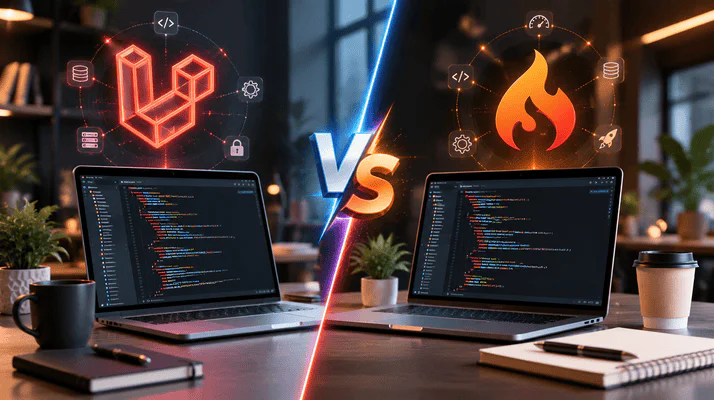
Laravel vs CodeIgniter: Which PHP Framework Is Better for Web Application Development in 2026?
The landscape of PHP web engineering has shifted dramatically. With modern web applications demanding real-time synchronization, massive data processing, and highly integrated artificial intelligence architectures, selecting your core programming foundation dictates your entire technical roadmap.
For years, the debate has centered on two historic giants: Laravel and CodeIgniter. Both platforms have evolved significantly, moving past legacy design philosophies to accommodate the high-performance runtimes of modern web servers.
Choosing between these frameworks is no longer about deciding which one is simply "better." Instead, modern engineering teams must analyze which framework aligns precisely with their operational scope, security compliance models, and scalability trajectories. Let us break down the real-world performance metrics, architectural layouts, and resource costs of both ecosystems.
Architectural Philosophy and Core Ecosystems
The ultimate divergence between these two systems lies within their fundamental design paradigms and what they provide out of the box.
Laravel: The Comprehensive Enterprise Hub
Laravel is engineered as a highly robust, full-stack application foundation. Operating primarily on the modern Model-View-Controller (MVC) architecture, it prioritizes a developer-first environment rich with built-in tools.
Laravel incorporates an expansive, native ecosystem including an advanced Object-Relational Mapper (Eloquent ORM), deep asynchronous queue managers, automated dependency injection containers, and first-party tool suites like Reverb for real-time WebSocket communication.
Furthermore, the launch of Laravel 13 has introduced native, core-level AI SDKs and vector search integrations, formalizing it as a forward-looking powerhouse for enterprise computing.
CodeIgniter: The High-Speed Minimalist Engine
CodeIgniter, specifically through its completely rewritten CodeIgniter 4 framework, approaches development from a perspective of absolute minimalism and speed. It honors the MVC standard but leaves models and views completely optional, giving developers complete autonomy over how they structure their microservices or back-end platforms.
Instead of bundling dozens of heavy database or queue abstractions, CodeIgniter provides an extremely lightweight footprint, a blazing-fast routing mechanism, and a streamlined query builder. It is built specifically for systems where memory efficiency and rapid execution are prioritized over extensive feature sets.
Performance, Memory Footprint, and Execution Velocity
When evaluating raw processing speed, CodeIgniter routinely outperforms its competitors. Thanks to its minimalist architecture, CodeIgniter initializes with very few core files, leading to minimal memory consumption and rapid request-response loops. If your application centers on delivering fast API endpoints, running on constrained cloud instances, or serving highly dynamic web dashboards with minimal server overhead, CodeIgniter offers a streamlined option.
Conversely, Laravel introduces a noticeable amount of initial framework overhead. Because it bootstraps comprehensive service providers, validation mechanisms, and database tracking systems for every individual request, its baseline memory usage is naturally higher.
However, modern deployment setups balance this variance effectively. By leveraging performance caching, opcache optimization, and tools like Laravel Octane powered by Swoole or RoadRunner, teams can run Laravel applications at exceptionally fast execution speeds, minimizing the historical performance gap in production environments.
Database Integration and Object Management
Laravel relies entirely on Eloquent ORM, allowing developers to interact with database records using intuitive, object-oriented syntax. While incredibly clean, complex Eloquent queries can lead to hidden database performance issues if not carefully optimized.
CodeIgniter utilizes an optimized query builder that uses less memory, providing a direct, fast connection to the database without heavy abstraction layers.
Security Architecture and Threat Mitigation
Both ecosystems provide comprehensive tools to protect against cross-site scripting (XSS), cross-site request forgery (CSRF), and SQL injection. Laravel handles security through built-in global middleware structures that automatically filter requests, manage authentication states, and handle encryption keys securely out of the box.
CodeIgniter provides strong, standalone security libraries that must be explicitly declared and configured by the engineering team within controllers or global routing definitions.
Development Speed, Scalability, and Long-Term Maintenance
For projects with strict timelines, Laravel development offers an incredibly rapid path to market. The framework includes pre-built starter kits for user authentication, multi-factor authorization, and API token management. Instead of spending weeks building core identity systems or data validation pipelines, developers can instantly jump into writing custom business logic.
However, the continuous framework evolution requires structural diligence. Maintaining large systems requires keeping pace with major release cycles, which demands regular updates to ensure compatibility with modern PHP runtimes.
Choosing CodeIgniter development requires writing more boilerplate code for features like user roles or external service connections, as it includes fewer built-in libraries. The trade-off is a highly stable, low-maintenance environment.
CodeIgniter applications rarely break due to ecosystem updates, allowing small engineering teams to build, deploy, and leave applications running smoothly for years without facing major technical debt or structural upgrades.
Finding and Retaining Specialized Engineering Talent
Your framework choice directly impacts your recruitment pipeline and operational budget. Because of its massive popularity, the global pool of developers is highly competitive. When you need to hire laravel developer, you gain access to an extensive ecosystem of professionals familiar with standardized enterprise design patterns. This widespread adoption shortens onboarding times, as new engineers can immediately understand the code repository's layout and migration structures.
Conversely, finding developers specialized in modern CodeIgniter 4 architectures can sometimes take longer, as many junior developers gravitate toward larger ecosystems. When you look to hire codeIgniter developer, you are often looking for engineers who value close-to-the-metal PHP development, custom routing systems, and highly optimized database workflows. While the talent pool is smaller, these developers excel at building agile, lightweight solutions without relying on heavy external dependencies.
Choosing Your Framework Architecture
Selecting the ideal foundation for your next web application depends on matching your immediate project needs with your long-term business goals.
Engineering Selection Blueprint
Select Laravel If:
Your application requires real-time data streaming, complex background jobs, native AI integrations, or an intricate multi-layered database model. It is the optimal choice for scaling SaaS platforms and enterprise applications.
Select CodeIgniter If:
You are building a lightweight web application, a fast microservices API, or a dynamic portal that must operate efficiently on budget-friendly shared hosting infrastructure. It excels in situations where minimal configuration and rapid execution speeds are paramount.
Aligning Framework Choice with Business Goals
Both PHP frameworks provide stable, modern platforms for building high-performing web applications. The decision ultimately comes down to a choice between extensive built-in features and lean, lightweight speed.
By analyzing your team's expertise, performance requirements, and long-term scalability goals, you can choose the framework that ensures an efficient, successful launch.
Sayantan Santra
Associate Mobile App Developer, Idiosys Tech
An Associate Mobile App Developer with 2+ years of experience, creates sleek and user-friendly apps. Skilled in both Android and iOS development, he focuses on delivering smooth performance and engaging user experiences.