Should You Build a Custom Food Delivery App or Customize a Ready-Made Solution in 2026?
The online food logistics sector is no longer just a luxury service for weekend convenience. It has turned into a vital, daily utility for urban communities worldwide. As the global online food delivery market moves toward an estimated $326.4 billion valuation this year, entrepreneurs and restaurant groups are racing to secure their market share.
However, entering this space brings a classic dilemma: choice paralysis. Business leaders frequently get stuck debating whether to invest in bespoke custom food delivery app development from the ground up, or deploy a pre-built white label food delivery app to save time and capital.
The decision is rarely simple. Selecting the wrong path can lead to wasted capital, missed market windows, or operational constraints that limit your capacity to scale. To make an informed decision, you need a clear breakdown of how both development strategies perform across the current engineering landscape.
Understanding the Landscape: The Multi-App Ecosystem
Before comparing deployment paths, it is important to recognize that modern food delivery app development is inherently complex. A functional platform is never just a single downloadable application. Instead, it requires building a coordinated multi-app ecosystem that syncs seamlessly in real time.
+-------------------------------------------------------+
| Central Cloud Server |
| (Database, Route Planning, & AI Engines) |
+-------------------------------------------------------+
|
+-------------------------+-------------------------+
| | |
v v v
+------------------+ +------------------+ +------------------+
| Customer App | | Merchant Panel | | Driver App |
| (Menu Browsing, | | (Order Ingestion,| | (Live Routing, |
| Payments, GPS) | | Inventory Sync) | | Status Updates) |
+------------------+ +------------------+ +------------------+
| | |
+-------------------------+-------------------------+
|
v
+--------------------------------------------------------------------+
| Central Admin Dashboard |
| (Payouts, Commissions, & Operational Insights) |
+--------------------------------------------------------------------+
The system requires a user-friendly frontend for customers to browse digital menus, process payments, and track live delivery routes. Simultaneously, restaurants need a specialized vendor management interface to accept orders, manage daily inventory, and push dynamic menu updates.
On the road, couriers need a lightweight, GPS-enabled mobile utility featuring smart navigation tools and instant pickup alerts. Finally, an overarching administrator control center ties everything together, allowing your operations team to monitor driver dispatching, resolve platform disputes, and process commissions. Managing these moving parts requires strong technical infrastructure.
Custom Food Delivery App Development: Total Autonomy and Tailored Scale
Opting for custom architecture means your team creates every single line of code, database structure, and user interface component from a completely blank slate. This path is ideal for brands that want to establish a completely unique, highly competitive product ecosystem.
Complete Intellectual Property and Data Mastery
With a custom build, you retain absolute ownership of the core system software and user data database. This model avoids recurring licensing fees and eliminates dependencies on third-party SaaS software providers. Having unfiltered access to user analytics also lets you integrate advanced machine learning engines to personalize menus and forecast peak delivery hours.
Unlimited Functional Scalability
Custom builds allow you to integrate advanced digital logistics directly into your tech stack. You can easily build automated route optimization systems, multi-location virtual brands, or voice-controlled ordering interfaces that connect with home smart assistants. This flexibility helps enterprise platforms maintain operational efficiency, even when processing tens of thousands of orders concurrently.
Ready-Made Solutions: Speed to Market and Cost Efficiency
For startups and local restaurant collectives, creating custom enterprise software from scratch can occasionally feel like over-engineering. Ready-made, white-label solutions provide an efficient shortcut to get your brand up and running quickly.
Rapid Deployment
A custom application build typically requires several months of engineering, quality assurance, and design before it is ready for public release. Conversely, a pre-configured solution can be rebranded, connected to local payment processors, and deployed to primary app stores in just a few weeks. This speed lets you test your business concept with real-world users almost immediately.
Lower Initial Capital Outlay
Building complex digital platforms from scratch demands a significant upfront investment to cover developer hours, interface design, and deep system architecture testing. Ready-made alternatives lower that financial barrier by utilizing pre-tested, shared software systems. This approach lets you allocate more of your early-stage budget toward restaurant onboarding and customer acquisition marketing campaigns.
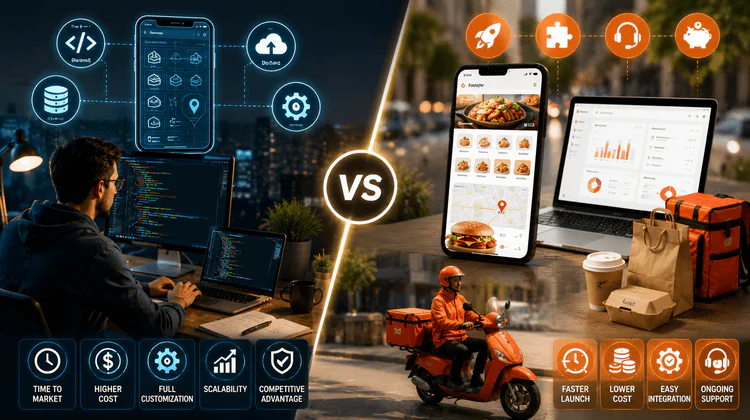
Direct Architectural Comparison
|
Strategic Dimension |
Custom Engineering Approach |
Ready-Made Framework |
|
Time to Market |
Typically 3 to 12 months of development |
Deployed in 2 to 4 weeks |
|
Upfront Financial Investment |
High initial capital required |
Very predictable, budget-friendly setup |
|
UI/UX Design Freedom |
Unrestricted, completely bespoke branding |
Limited to preset structural themes |
|
System Modification Potential |
Completely adaptable to changing trends |
Bound by provider configuration options |
|
Platform Scalability |
Built to scale with cloud-native infrastructure |
Dependable for standard operational volumes |
Key Questions to Help Guide Your Choice
If you are experiencing decision paralysis, reviewing these core business parameters can help clarify the right direction for your platform.
- What is your immediate budget? If you are operating as an early-stage startup trying to validate a proof-of-concept, starting with a streamlined white-label framework minimizes initial financial risk.
- What does the regional competitive landscape look like? If your local market is already saturated by dominant delivery aggregators, you need custom features—like advanced loyalty systems or predictive AI routing—to stand out.
- How complex are your daily logistics? Platforms managing diverse multi-brand virtual kitchens require highly flexible backend sync capabilities that basic out-of-the-box setups rarely support.
Idiosys: Delivering Flexible and Scalable Mobile Engineering Options
Building a dependable, high-traffic digital logistics platform requires a deep understanding of modern cloud architectures and mobile integrations. You need an engineering team that can align technical strategies with your budget constraints and growth plans.
Idiosys stands out as an experienced mobile app development company that rejects rigid, one-size-fits-all engineering frameworks. They provide versatile options for mobile app development, helping brands launch responsive pre-built foundations or build highly custom, scalable software architectures from the ground up.
Whether your goal is to launch a localized delivery app using a cost-efficient ready-made structure or build an enterprise-grade platform capable of managing thousands of concurrent users, Idiosys provides the technical expertise to turn your ideas into functional products. They handle the underlying complexities of live API integrations, driver route optimization, and secure checkout frameworks, letting you focus entirely on scaling your merchant network.
Launch Your Food Delivery Platform
The global food delivery landscape is moving quickly, and success depends on picking a technical foundation that matches your business model. Whether you prioritize total custom flexibility or a fast, cost-effective initial launch, the most important step is choosing a scalable path forward.
Are you ready to build a reliable digital presence? Reach out to the software engineering specialists at Idiosys today to discuss your project goals and map out a deployment strategy tailored to your brand.
You May Also Read
The Role of AI in Optimizing Food Delivery Routes and Reducing Costs
How a food delivery app can transform your restaurant business in 2023
6 Engaging Features of Food Delivery App to get success
Sayantan Santra
Associate Mobile App Developer, Idiosys Tech
An Associate Mobile App Developer with 2+ years of experience, creates sleek and user-friendly apps. Skilled in both Android and iOS development, he focuses on delivering smooth performance and engaging user experiences.