Integrating Quick Commerce with Existing Retail Ecosystems: Lessons from Multi-Channel Success Stories
The retail landscape is undergoing a fundamental shift. For decades, success was defined by the strength of physical store networks and the efficiency of legacy Enterprise Resource Planning (ERP) systems. Today, a new imperative has emerged: the ability to deliver goods in minutes, not days. This is the domain of the quick commerce platform, and for established retailers, the challenge is not just to adopt it, but to integrate it seamlessly with their existing infrastructure.
The market's trajectory is clear. In India alone, the quick commerce market was valued at ?25,300 crore in FY2024-25, with a staggering 49% compound annual growth rate projected through 2028. This explosive growth, fueled by consumer demand for instant gratification, has turned quick commerce from a novelty into a necessity. However, for brands already operating physical stores and managing complex supply chains, the question is not why to integrate a q commerce platform, but how.
The Integration Imperative: Beyond the Silos
The greatest obstacle to successful integration is not a lack of ambition, but the presence of data silos. In many retail operations, the physical store, the ecommerce marketplace channel, and the warehouse management system operate as distinct entities. This fragmented approach is a silent speed killer, making it almost impossible to meet the 10-minute delivery SLAs that define modern quick commerce .
According to industry analysis, data silos can raise operational costs by 20-30%. The inefficiencies manifest in several ways. A legacy system might update inventory only once a day, meaning a product sold in-store could still appear available on a quick commerce app, leading to cancellations and customer frustration. This disconnect is also a major contributor to the high closure rate of small retail stores, as neighborhood shops struggle to compete with the seamless digital experience of larger players.
The solution lies in creating a "single source of truth" for your business. By unifying inventory, order management, and fulfillment data, retailers can eliminate the friction points that plague multi-channel operations. This unified approach is not just about speed; it's about accuracy and building customer trust.
The Architecture of a Successful Integration
Integrating a q commerce platform into a legacy retail ecosystem requires a strategic, three-pronged approach, focusing on technology, operations, and inventory.
1. Unified Technology and Data Infrastructure
This is the foundation upon which all else is built. Moving away from disparate systems towards a centralized ecommerce website development and logistics architecture is crucial.
- Beyond the ERP Handshake: Legacy ERPs are not built for the microsecond accuracy of quick commerce. While a one-way data push might suffice for standard operations, real-time Q-commerce requires a continuous two-way data flow. For instance, modern delivery management platforms are designed to write back to the ERP in real-time—every dispatch, status update, and proof of delivery updates the central record instantly, eliminating manual reconciliation delays and reducing errors that bog down finance teams .
- Native Integration Over Bolt-Ons: The ideal integration is native, not an afterthought. Ecommerce website development in this context means building a tech stack that can communicate seamlessly with your ERP, POS, and warehouse systems. Platforms that offer pre-built connectors reduce the time-to-launch and eliminate costly custom API development projects.
- The Control Tower: A unified logistics management solution acts as a "control tower," providing an AI-powered monitoring system that evaluates data, identifies problems, and takes corrective action automatically . This reduces the burden on logistics teams, allowing them to focus on strategy rather than firefighting.
2. Operational Agility: From POs to Last-Mile
A quick commerce integration lives and dies by its operational efficiency. The goal is to automate every touchpoint.
- Automated PO Processing: Traditional platforms like Blinkit and Zepto can raise multiple purchase orders (POs) daily per location. Manual processing creates a backlog that can lead to empty shelves and missed SLAs . An effective integration automates PO validation and routing directly to warehouse workflows.
- Seamless Warehouse and Transport Handoff: The most critical point of failure is the handoff between warehouse and delivery. A q commerce platform must ensure that when an item is picked, the transportation system is immediately aware. This includes features like micro-sector sorting, where delivery areas are divided based on real-world factors like traffic patterns, rather than administrative boundaries . This ensures the right order is picked and dispatched to the correct delivery partner with maximum efficiency.
- ASN and GRN Automation: Advance Shipment Notices (ASNs) must be pushed to the delivery platform before the truck leaves the warehouse to prevent delays at the dark store dock. Similarly, automated reconciliation of Goods Received Notes (GRNs) against dispatch data is essential for financial accuracy, preventing weeks of manual spreadsheet work .
3. Inventory as a Fungible Asset
In a modern retail ecosystem, inventory should be fungible—it can flow where and when it’s needed.
- Real-Time Inventory Sync: Stock levels must be synchronized across all channels—physical stores, dark stores, and the ecommerce marketplace—in real-time to prevent overselling . This requires an inventory allocation strategy that reserves stock for specific channels, preventing a high-demand SKU on your D2C site from being depleted by a quick commerce order.
- Strategic Inventory Placement: A key lesson from successful integrations is the strategic placement of inventory. For example, a retailer can use its network of physical stores as micro-fulfillment centers. By leveraging a store's existing stock and local geographical knowledge, they can serve as a quick commerce layer for the brand without needing to build new dark stores . This co-location model minimizes infrastructure investment and accelerates go-to-market speed.
Lessons from Multi-Channel Success
The most successful multi-channel retailers understand that integration is a continuous process of optimization. They have learned to manage the complexities of scale, often transitioning from a fragmented, manual process to an automated, unified one.
This evolution is not without its challenges. Many brands are becoming aware of the high commission rates and intense competition on Q-commerce platforms and are diversifying their distribution channels to improve margins . However, their continued investment in Q-commerce proves that the channel is not a fad; it is a critical component of a modern retail strategy.
Conclusion: Building the Future of Retail
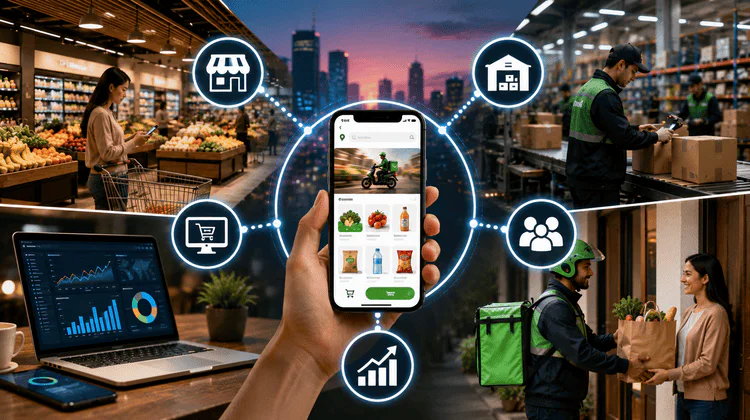
Integrating a quick commerce platform with an existing retail ecosystem is one of the most complex, yet rewarding, strategic moves a business can make. It requires a fundamental shift in mindset from viewing online and offline as separate channels to seeing them as a single, integrated fulfillment network. By investing in a unified technology infrastructure, automating operational touchpoints, and treating inventory as a fungible asset, retailers can not only meet the demand for speed but also build a resilient, future-proof business model. The retailers who succeed will be those who effectively bridge the gap between their legacy systems and the new expectations of the instant economy.
Q&A: Common Integration Challenges
Q: What is the biggest challenge when integrating a quick commerce platform with a legacy ERP?
A: The primary challenge is achieving real-time, bidirectional data sync. Many legacy systems are not designed for the constant stream of updates that quick commerce demands, leading to data silos and operational bottlenecks.
Q: How long does it typically take to integrate these systems?
A: The timeline can vary significantly. With modern platforms offering pre-built connectors and APIs, some brands report going live in as little as seven days, provided the internal readiness is there .
Q: Does quick commerce integration require building new dark stores?
A: No. A successful integration strategy can leverage existing assets. One effective approach is to use existing retail stores or warehouses as micro-fulfillment centers, rather than building new infrastructure from scratch
You May Also Read
Custom Quick Commerce Platform Development: Key Features, Challenges, and Proven Solutions
Shreya Roy
Junior Full Stack Web Developer, Idiosys Tech
A Junior Full Stack Web Developer with 1.5+ years of experience, builds responsive and user-friendly websites. Skilled in both front-end and back-end technologies, she is passionate about creating efficient and scalable digital solutions.