Boost Your Online Sales with Our Custom E-commerce Solutions

  • We are specialists in both marketplace development and single-vendor e-commerce!
  • Implementation of secure payment gateways and compliance with industry standards.
  • Scalable solutions designed to grow with your business
The Idea

Best eCommerce Website Development Company

The right eCommerce build isn't the one that launches fastest — it's the one still holding up at ten times the traffic.
546

Applications launched across industries since 2015.

159

Clients worldwide — most stay long past the first launch.

An eCommerce website needs to make shopping simple for customers while also being practical for the business to manage. Product categories, page structure, mobile usability, checkout steps and store administration all affect how well the website works. If these areas are not planned properly customers may find it difficult to locate products or complete a purchase.

Idiosys Technologies works as an eCommerce website design company in Kolkata for businesses that need online stores based on their products and customer requirements. Our team works on store layouts, product pages, category structure and key buying steps so the website remains clear and easy to use across desktop and mobile devices.

As an eCommerce company in Kolkata we support businesses from different industries in India and overseas. Project support is available from Kolkata, the USA and the UK. Before development begins we review the product range, business model, customer journey and operational requirements so the website structure can be planned around actual needs.

Some businesses require features that are not available in a standard online store. Idiosys Technologies also works as an eCommerce application development company in Kolkata for projects that involve custom functions or business-specific workflows. These requirements may include product variations, customer accounts, third-party integrations, order management processes or other features related to the way the business operates.

Our work as an ecommerce website development company in Kolkata covers planning, interface development, product and category setup, responsive layouts, checkout functionality, analytics integration, testing and launch support. Technical requirements are discussed before development so the scope is clear and unnecessary changes can be reduced during later stages.

Idiosys Technologies has completed more than 250 eCommerce projects across different industries. This experience has given our team practical exposure to different product types, store structures and customer journeys. A business with a small product range may need a simple category system while a larger catalogue may require filters, multiple product levels and more detailed navigation.

Businesses looking for an ecommerce development company should review more than the visual appearance of a store. Mobile performance, page speed, checkout flow, product management and future requirements are also important. Customers should be able to move from product discovery to purchase without unnecessary steps while staff should be able to manage products and orders without making routine tasks complicated.

Our e-commerce development services can support businesses that are starting a new online store or making changes to an existing platform. The work can be planned around the current condition of the website and the functions that need improvement.

Idiosys Technologies provides eCommerce website and application development according to the scope of each project. The focus remains on usability, store management and technical requirements rather than adding features that are not necessary for the business.


Capabilities

What we build.

Four commerce disciplines held to the same production standards — catalog architecture, storefront performance, checkout, and everything the order touches after payment.

Product Category Management:

By this admin feature you can manage Category & Sub Category could be created and linked. This feature helps the Shopping portal owner to mange product very easily.

Next.jsHeadlessCore Web Vitals

Product Management

By this feature admin can change the information about any product for product details page. This feature helps to create unique and details information about any product.

Vendor onboardingSplit payoutsCommission engine

Discount Management

By this Portal owner offer discount to user on Category wise and individual product wise or Brand wise. By this you can create marketing activity for your shopping portal.

Shopify / MagentoSEO-safe cutoverData migration

Offer Banner Slider

We can provide some promotion banner for different category or brand wise. so you can promote your product from banner.

PCI-alignedMulti-gatewayERP / POS sync

Content Management

This facility helps page owner to manage informational page related content for update shipping policy, privacy policy and others page

Coupon Management

By this we support your promotional and marketing activity. You can create coupon like “SUNDAYDEAL20” (20% Discount) this will applicable for any day or time frame on any product/category.

Delivery Product Management

By this features you can assign any delivery boy to some location (pin code wise). You get a brief about the order and delivery status of any pin code or location.

Zip Code Management

By this features you can assign any delivery boy to some location (pin code wise). You get a brief about the order and delivery status of any pin code or location.

Common pitfalls

Why most online stores underperform

Revenue rarely leaks where teams look for it. These are the failure modes we see most often on stores that were built to spec and still miss their numbers — each one preventable.

~70%

of online carts are abandoned before payment. Most of that loss traces to slow pages, forced sign-ups, and checkout friction — not price.

Industry consensus · Baymard Institute

Failure Mode

Slow catalog and product pages

Heavy hero images, unoptimized media, and a dozen third-party scripts push product pages past three seconds on mobile — where most of your traffic is.

Our Guardrail

Per-template performance budgets

Home, category, product, and checkout each get a measured LCP and INP budget enforced in CI. Media is served responsive and CDN-cached by default.

Failure Mode

Checkout friction

Forced account creation, a five-step form, surprise shipping costs at the last screen. Buyers with intent leave at the step that asks the most.

Our Guardrail

Guest checkout, measured step by step

One-page checkout with guest flow, wallet and UPI options, and address autofill. Drop-off is instrumented per field so we fix the real step, not the suspected one.

Failure Mode

Replatforming that wipes out SEO

A new store launches with new URLs and no redirect map. Organic traffic falls 40–70% and takes months to recover — if it recovers.

Our Guardrail

301 map and parity audit before cutover

Every legacy URL is crawled, mapped, and redirected. Metadata and structured data carry over page-by-page, validated on staging and monitored daily post-launch.

Failure Mode

Inventory and order data drift

Storefront, ERP, and warehouse disagree on stock. Oversells, cancellations, and refund tickets become a daily operations tax.

Our Guardrail

One source of truth, idempotent sync

A defined system of record per data domain, event-driven sync with retries and dead-letter queues, and reconciliation reports that surface drift before customers do.

Failure Mode

Silent payment failures

A gateway times out, webhooks are missed, orders land as paid-but-unfulfilled or vanish entirely. Nobody notices until the numbers are reconciled.

Our Guardrail

Multi-gateway fallback with alerting

Retries, idempotency keys, webhook replay, and a fallback gateway. Failed-payment and stuck-order rates are alerted on, not discovered at month-end.

Failure Mode

Fragility on sale days

The store that ran fine all year folds in the first hour of a campaign — usually at checkout, exactly when every visitor is worth the most.

Our Guardrail

Load-tested to your real peak

Checkout is load-tested to 3–5× your highest historical hour. CDN caching, read replicas, queue-backed order processing, and autoscaling keep the buy path alive under catalog load.

Our process

A clear path from kickoff to first order.

A repeatable delivery rhythm — every commerce engagement runs the same playbook, so you know what each week looks like and what lands at the end of it.

  1. 01Week 1

    Discovery & commerce audit

    We map catalog structure, pricing rules, checkout flow, integrations, and the funnel numbers you want to move. Output: a written scope and a measurable definition of done.

    Funnel auditScope
  2. 02Weeks 2–3

    Architecture, catalog & UX

    Platform decision, data model for products and variants, search and merchandising design, checkout wireframes, and the SEO and URL plan for launch or migration.

    System designURL plan
  3. 03Weeks 4–8

    Storefront & checkout build

    A production-ready slice goes to staging early — real catalog, real search, real checkout in sandbox — and gets benchmarked against the performance budget from day one.

    First deployPerf baseline
  4. 04Weeks 9–11

    Payments, integrations & hardening

    Live gateways, tax and shipping rules, ERP and POS sync, security review, load testing to peak, and analytics and observability wired end to end.

    Load testPCI-aligned
  5. 05Launch

    Cutover & migration

    Staged rollout with redirects live, order and customer data migrated, admin team trained, and index coverage plus checkout health watched daily through the first weeks.

    301 redirectsTraining
  6. 06Ongoing

    Growth & optimization

    Conversion experiments, merchandising and search tuning, seasonal readiness, platform upgrades, and new feature delivery on a monthly roadmap.

    A/BSLA
Cost control

Engineered to protect your budget.

Five operating rules that keep commerce engagements on-spec, on-time, and on-budget — backed by transparent weekly reporting.

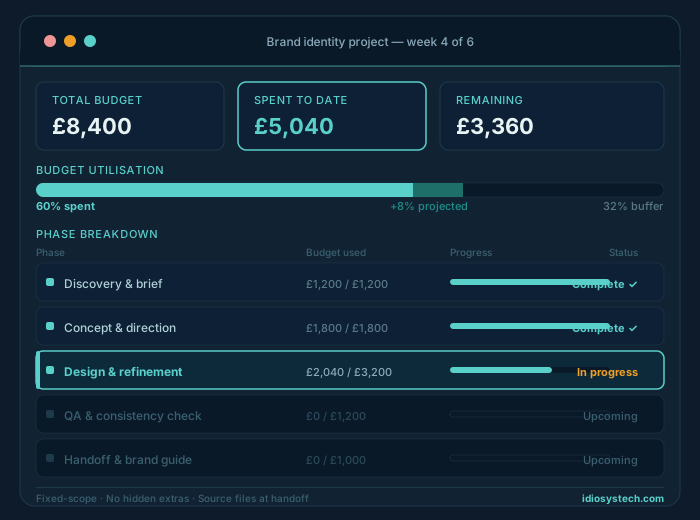
Example of the weekly cost and progress report sent to every active client

A redacted example of the weekly report every active client receives — same format regardless of engagement size.

  1. 01

    Fixed-scope, fixed-price phases

    Every phase ships with a written scope and a fixed price. Scope changes pause work and trigger a written change order — never a surprise invoice.

  2. 02

    Hard budget caps

    We pause at 90% of the cap and check in. You decide whether to continue, descope, or wrap — no overrun email the week after a sprint closes.

  3. 03

    Weekly burn reports

    Every Friday you receive a one-page report: hours, spend, what shipped, what is next. It reconciles to the invoice line-by-line.

  4. 04

    Senior-only billing

    You pay for engineers who can ship — no padded teams of juniors learning on your budget. Average tenure across our delivery team is 6+ years.

  5. 05

    Platform & running-cost optimization

    Licence tiers, transaction fees, search and image services, and cloud spend are reviewed every sprint — so a store that converts better does not also cost more to run.

Case studies

Real implementations, sanitized.

Three production commerce builds with the architecture and outcomes our clients consented to share. Names redacted on request.

Case · 01

Fashion Storefront Replatform

Fashion · Next.js + headless · 12 weeks

A themed store capping mobile conversion, with product pages past four seconds. Rebuilt as a headless storefront with CDN-cached rendering, faceted search, and a one-page guest checkout — migrated behind a full 301 map with no ranking loss.

2.4×
faster product pages
+31%
mobile conversion
Case · 02

Multi-Vendor Marketplace

Marketplace · Node + Postgres · 20 weeks

Vendor onboarding, catalog moderation, and payouts were being run on spreadsheets. Built a marketplace platform with self-serve vendor onboarding, commission rules, automated split payouts, and dispute workflows.

850+
vendors onboarded
−64%
order-ops time
Case · 03

B2B Wholesale Portal

Manufacturing · React + ERP sync · 16 weeks

Distributor orders arrived by email and phone, then were keyed into the ERP by hand. Built a B2B portal with customer-specific price lists, credit terms, bulk reordering, and hourly two-way ERP sync.

12K
SKUs synced hourly
−48%
manual order entry
Industry applications

Commerce we know.

Six sectors where we have shipped commerce platforms — each with its own catalog shape, margin structure, and fulfilment reality.

Fashion & Apparel

Variant-heavy catalogs, size and fit guidance, lookbook merchandising, and returns flows built for a high-exchange category.

Grocery & Quick Commerce

Slot-based delivery, dark-store and zone inventory, substitutions, and checkout tuned for high-frequency repeat baskets.

Furniture & High-Value Retail

Configurable products, room visualisation, freight and installation logic, and EMI or financing at checkout.

Health & Wellness

Subscriptions and refills, restricted-product rules, prescription workflows, and consent-aware customer data handling.

B2B & Wholesale

Account hierarchies, negotiated price lists, quote-to-order, credit terms, bulk reordering, and ERP-backed inventory.

Marketplaces & Aggregators

Vendor onboarding and KYC, commission and payout engines, catalog moderation, and multi-seller fulfilment tracking.

Engagement

Three ways to work with us.

Pick the one that matches where you are. Not sure? Talk to us — we'll recommend based on your goals, timeline, and risk appetite.

2–4 weeks · fixed price

Commerce Audit & Roadmap

For stores that are live but underperforming. We audit performance, funnel, catalog, and integrations, then write a prioritised plan with expected impact.

  • →Funnel & checkout teardown
  • →Performance & SEO audit
  • →Platform fit assessment
  • →Written roadmap with phases
Best whenthe store is live but the numbers are not moving.
Most Popular
8–20 weeks · fixed scope

Storefront Build or Replatform

End-to-end: architecture through launch. Catalog, storefront, checkout, payments, integrations, and an SEO-safe migration if you are moving platforms.

  • →Architecture & catalog model
  • →Storefront & checkout build
  • →Payments & ERP integrations
  • →301-mapped cutover + handover
Best whenyou are launching, or outgrowing what you have.
Ongoing · monthly retainer

Embedded Commerce Team

A senior squad inside your team — running experiments, shipping features, keeping peak season boring, and owning the platform roadmap with you.

  • →Dedicated engineers
  • →SLA-backed support
  • →Conversion experiments
  • →Peak-season readiness
Best whencommerce is your revenue engine and needs to keep evolving.
FAQ

Questions we get asked.

It depends on where your complexity lives. If your catalog, pricing, and checkout are conventional, a hosted platform gets you live faster and cheaper — and we will tell you so. Custom becomes the right call when you need multi-vendor payouts, B2B pricing tiers, deep ERP or POS integration, or a checkout flow the platform will not let you change. We often build a hybrid: a headless custom storefront on top of a commerce engine, so you keep the platform's payment and tax plumbing while owning the experience.
Ready when you are

Let's build a store that converts.

Send a short brief — what you sell, where the funnel leaks, what platform you are on and what it is costing you. We'll come back within one business day with an architecture sketch and an honest read.