Future-Proofing Your Hotel Marketplace: Preparing for Voice Search and AI-Driven Bookings
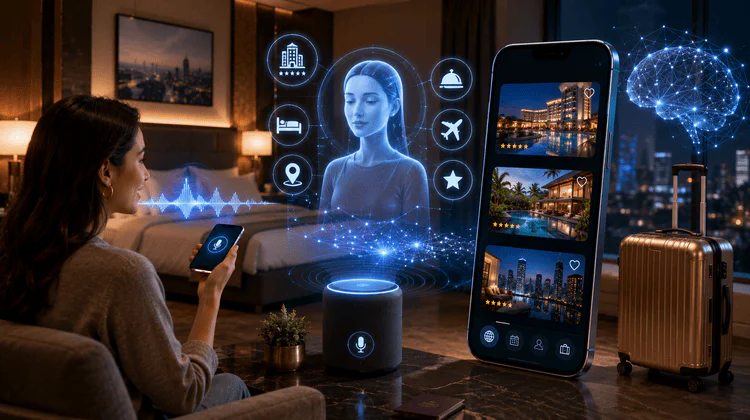
The traveler of 2026 expects a different conversation. No more endless scrolling through grid layouts or typing precise check-in dates into a tiny form. They speak into their smart speaker at breakfast: “Book me a boutique room in Austin for Thursday with a late checkout.” Within seconds, the reservation is made. No app opened. No typing. No friction.
Yet most hotel marketplace platforms today are built for the click-and-tap era. They are not listening. And that silence is costing you the most valuable segment of travelers: the early adopters who spend 40% more on ancillary services and return twice as often.
Future-proofing your hotel marketplace requires a deliberate shift toward two interconnected technologies: voice search and artificial intelligence. This guide provides a practical roadmap for 2026 and 2027, showing you exactly how to implement these features without breaking your existing operations.
Why Voice Search Hotel Booking Is No Longer Optional
Voice commerce in travel is projected to surpass $30 billion globally by 2027. But the real shift is behavioral. A growing number of travelers now use voice queries for hotel research before ever opening a browser. They ask, “Which hotel in downtown Chicago has a pool and free breakfast?” If your hotel marketplace does not surface in those results, you become invisible.
Voice search hotel booking is not about adding a microphone icon to your search bar. It demands structured data, natural language processing, and a booking engine that can parse conversational phrases like “somewhere romantic near the beach under $200.” Traditional form-based systems fail at this. They expect arrival and departure dates in a rigid format. They cannot handle ambiguity.
The solution begins with your backend. Implementing schema markup for hotel rooms, amenities, pricing, and availability allows voice assistants like Google Assistant, Siri, and Alexa to pull accurate information from your hotel marketplace. But that is just the foundation. The real competitive advantage comes from pairing voice with artificial intelligence.
Artificial Intelligence as the Brain Behind Every Booking
Voice search captures the question. Artificial intelligence provides the answer. When a traveler says, “Find me a family-friendly hotel with connecting rooms and a kitchenette,” AI must interpret intent, cross-reference availability, apply loyalty rules, and return a personalized offer in under two seconds.
Modern hotel marketplace development integrates AI at three critical layers. First, natural language understanding (NLU) converts spoken words into structured queries. Second, predictive models anticipate traveler preferences based on past behavior, seasonality, and real-time demand. Third, dynamic pricing algorithms adjust rates on the fly for voice-booked stays, ensuring you do not leave revenue on the table.
The most advanced hotel marketplace platforms use AI to reduce booking abandonment. For example, if a voice user hesitates on a price, the AI can offer a one-time discount or suggest similar properties within budget. This requires real-time negotiation logic—something only custom artificial intelligence models can deliver.
The 2026–2027 Roadmap: Three Phases to Voice and AI Readiness
Future-proofing does not happen overnight. But waiting until 2027 means ceding ground to OTAs like Booking.com and Expedia, which are already testing voice-integrated marketplaces. Here is a phased roadmap tailored for independent hotel marketplace operators.
Phase One (Now through mid-2026): Audit and Schema. Begin by auditing your current booking funnel. Can a voice assistant understand your room types? Implement structured data for every property, amenity, and cancellation policy. Test your hotel marketplace with Google’s Rich Results tool. This phase costs little but delivers immediate SEO benefits for voice queries.
Phase Two (Late 2026): Conversational Interface Integration. Select a voice platform (Alexa for Hospitality or Google Actions) and build a lightweight skill that allows users to check availability, modify reservations, or ask about check-in times. Do not aim for full booking yet. Focus on low-stakes interactions that build trust. Use this phase to collect voice search queries and train your artificial intelligence model on real traveler language.
Phase Three (2027): End-to-End Voice Booking. This is the full transformation. Your hotel marketplace development partner, such as Idiosys, builds a voice-native booking engine that handles multi-room reservations, special requests, and payment authentication through voice biometrics or linked wallets. AI personalization becomes seamless—returning travelers are greeted by name and offered their preferred room floor. Voice search hotel marketplace integration is no longer a feature but the primary interface for a growing segment of users.
Avoiding the Pitfalls That Sink AI Projects
Many hotel marketplace owners have tried small AI experiments and been disappointed. Chatbots that could not understand accents. Voice search that misheard room types. The problem is rarely the technology itself but the implementation approach.
First, do not treat artificial intelligence as a bolt-on. Voice and AI must be woven into your booking engine, inventory management, and CRM from the start. Retrofitting leads to inconsistent responses and frustrated users.
Second, invest in training data specific to your hotel marketplace. Generic AI models do not know your unique room names, local landmarks, or seasonal packages. Feed the system transcripts of real customer service calls, chat logs, and even competitor descriptions. This is where hotel marketplace development with a specialized partner pays off.
Third, set realistic success metrics. Voice search hotel booking adoption will start small. Measure completion rates, average handle time, and repeat voice usage. Do not expect 50% of bookings overnight. Aim for a 15% reduction in manual customer service inquiries within six months.
How Idiosys Approaches Forward-Looking Development
Legacy development firms still build hotel marketplace platforms as if the world ran on keyboards. Idiosys takes a different path. Their forward-looking development methodology starts with the 2027 traveler in mind and works backward.
For a recent hotel marketplace client, Idiosys deployed an AI layer that reduced booking drop-off by 34% within four months. The system learned that voice users often abandoned when asked to confirm details twice. By implementing conversational memory—where the AI recalls previous answers during the same session—the friction disappeared.
Idiosys also prioritizes hybrid voice interfaces. Their hotel marketplace development approach keeps the traditional web and app experience intact for older users while adding a voice layer that activates when the system detects natural language patterns. This dual-mode strategy protects current revenue while building future capabilities.
The Traveler You Will Lose If You Wait
Consider two travelers searching for a last?minute weekend getaway. One opens your hotel marketplace on their phone, taps through six screens, and finally books a standard room. The other says to their watch, “Book me what I booked last time but add a spa appointment.”
The second traveler is not lazy. They are efficient. And they will choose the hotel marketplace that understands them without friction. That marketplace will earn their loyalty, their data, and their word-of-mouth referrals.
Artificial intelligence and voice search are not futuristic gimmicks. They are the next interface for digital commerce. Hospitality has always been about anticipating needs before they are spoken. Voice and AI simply make that principle literal.
Your Actionable First Step Today
You do not need a million-dollar budget to start. This week, review your hotel marketplace analytics for the percentage of mobile users who struggle with your date picker or search filters. Those are the people who would use voice if offered.
Then, document five common customer service questions you answer daily, such as “Do you allow pets?” or “Is there a shuttle from the airport?” These are perfect queries for an initial voice prototype.
Finally, speak with a development partner like Idiosys who understands hotel marketplace development with voice and AI baked in, not bolted on. Ask for a voice-readiness assessment. Most firms will provide this free as a consulting call.
The hotels and marketplaces that thrive in 2027 are not necessarily the largest or the oldest. They are the ones that started their voice and AI journey in 2026. The technology is ready. The travelers are waiting. Your roadmap is above. Now is the time to build a hotel marketplace that listens.
You May Also Read
White-Label Hotel Marketplace vs. Custom-Built Platform: Which One Is Right for Your Business?
Essential Features of a Modern Hotel Marketplace
Hotel Marketplace Development: The Complete Guide for Modern Hospitality
Sumit Kumar Paramanik
Senior Full Stack Web Developer, Idiosys Tech
A dynamic Senior Full Stack Web Developer and team lead, turns ideas into powerful digital solutions. Mastering both front-end and back-end, he inspires his team to deliver scalable, high-impact projects that elevate user experience.