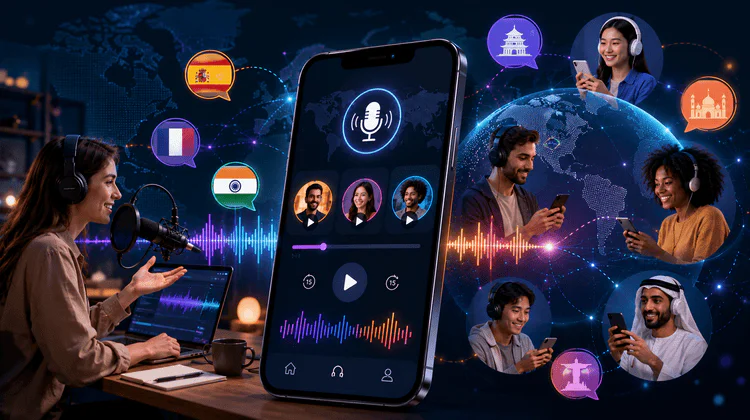
Multi-Language Podcast App Development: Solving Localization Problems for International Growth
Your podcast has a loyal following. Episodes are downloaded thousands of times. Engagement metrics look healthy. But somewhere beyond your home country, potential listeners are scrolling past your show—not because the content is weak, but because the language is wrong. That quiet frustration is the silent killer of international growth.
Language barriers remain the most overlooked bottleneck in podcast app development. Even the most compelling narratives fail to travel when users cannot understand, navigate, or discover content in their native tongue. The solution lies not in simple translation, but in strategic localization built directly into your application’s architecture.
This guide walks you through the real problems of audience limitation due to language, the essential features that solve them—translation, subtitles, and discovery tools—and a proven localization framework inspired by Idiosys global localization strategy.
The Silent Barrier: Why Language Limits Your Podcast’s Reach
Consider the numbers. Over 7,000 languages are spoken worldwide, yet the vast majority of podcast content exists in English, Spanish, Hindi, and Portuguese. If your app supports only one language, you are deliberately ignoring billions of ears. A listener in Berlin might love your business podcast, but if the interface, episode titles, and show notes are all in English, the friction is too high.
Traditional mobile app development often treats localization as an afterthought. Developers build the app first, then attempt to tack on language options. That approach leads to broken UI strings, misaligned subtitles, and search functions that cannot handle non?Latin scripts. The result? Poor user reviews and abandoned downloads.
A truly multilingual podcast app must be designed from the ground up with linguistic diversity as a core requirement. This means rethinking how audio, text, and metadata interact across different cultural contexts.
From Translation to True Localization: The Core Features
Machine translation has improved dramatically, but podcast localization demands more than word?for?word conversion. The first layer is dynamic interface translation. Every button, menu, and settings screen should automatically switch to the user’s preferred language. This sounds basic, yet many apps still require users to dig three menus deep just to change the language.
The second layer is episode metadata. Titles, descriptions, and show notes must be translatable without breaking character limits or losing keyword relevance. A skilled mobile app development company will implement a content management system where podcasters can upload pre?approved translations or integrate with professional translation APIs. Automated translation is acceptable for user?generated comments, but for premium content, human review remains critical for accuracy and brand voice.
Third is audio itself. While dubbing is expensive and often unnatural, many successful multilingual apps offer “separate audio tracks” similar to streaming video platforms. A listener can choose between the original language or a dubbed version. However, for most independent podcasters, the most practical approach is a combination of original audio with high?quality subtitles and transcripts.
Subtitles and Transcripts: Accessibility Meets SEO
Subtitles are not just for hearing?impaired users. In a noisy environment or when a listener wants to skim before committing, on?screen text dramatically improves engagement. For a multilingual podcast app, subtitles become a bridge language. A native French speaker can follow an English podcast with French subtitles, gradually improving their English while never missing the content.
But the real SEO power lies in transcripts. Search engines cannot index audio, but they can index text. When your app automatically generates and translates transcripts, those translations become searchable content. A user searching for “leadership tips in Japanese” could find your English podcast simply because the Japanese transcript exists and ranks in search results.
Implementing this requires careful planning. Speech?to?text accuracy varies by language. A robust podcast app development process includes selecting transcription APIs that support the target languages, handling timestamps, and allowing manual corrections. The best systems also segment transcripts into bite?sized, scannable paragraphs that display inline while the audio plays—creating a reading?while?listening experience that keeps users glued to the screen.
Discovery Tools: Helping Global Listeners Find You
Localization does not end when a user opens an episode. Before that, they need to find your content. Discovery tools are the neglected stepchild of international podcast apps. Standard keyword search fails miserably across languages because a term like “finance” has dozens of translations, synonyms, and cultural variations.
A smarter approach combines three tactics. First, implement cross?lingual search indexing, so a query in Spanish returns relevant episodes where the English metadata contains related concepts. Second, use curated category translations—ensure “Comedy” in your app maps to “Comédie” in French, “Komödie” in German, and “??” in Chinese, not literal machine translations that confuse users.
Third, leverage collaborative filtering. If users in Brazil who listen to episode A also enjoy episode B, the recommendation engine should work regardless of language. These features require back?end sophistication, but they directly drive retention in international markets.
Idiosys Global Localization Strategy: A Blueprint for Success
Theory is useful, but execution wins. The Idiosys global localization strategy provides a practical roadmap for any organization serious about mobile app development for international podcast audiences. Idiosys approaches localization as a continuous loop rather than a one?time project.
The strategy begins with linguistic auditing. Before writing a single line of code, you identify which 3–5 languages offer the highest return on investment based on your existing listener data and market trends. Then you design the app’s database schema to store all text fields as locale?aware key?value pairs. This prevents the classic mistake of hard?coding strings.
Next comes phased rollout. Launch with full interface translation and subtitles for your most popular episodes. Measure engagement per language cohort. If Japanese users suddenly spend 40% more time in the app, you invest in Japanese audio dubbing for new episodes. Simultaneously, you build a community feedback loop where multilingual users can suggest better translations—turning your audience into an asset.
Finally, Idiosys emphasizes cultural adaptation, not just linguistic. A joke that works in New York may fall flat in New Delhi. Release notes, promotional banners, and onboarding flows must be reviewed by native speakers who understand local humor, taboos, and references. This level of care transforms a functional app into a beloved local presence.
Why Partner with a Mobile App Development Company
Attempting to build all these features in?house can overwhelm even experienced teams. A specialized mobile app development company brings pre?built localization modules, experience with speech APIs, and knowledge of app store optimization across different regions. They also help avoid common pitfalls, such as incorrectly handling right?to?left languages or forgetting to adjust date and number formats.
When vetting potential partners, ask specific questions: Which translation management systems do they integrate with? How do they handle offline transcript caching? What is their process for testing subtitles on low?bandwidth connections? The right partner will treat multilingual support as a core feature, not a scope creep.
Conclusion: Your Next Episode Has a Global Audience
Language no longer has to be a wall. With thoughtful multilingual podcast app design, accurate subtitles, and discovery tools that cross cultural boundaries, your content can reach listeners from Seoul to São Paulo. The investment in localization pays back through increased downloads, longer session times, and a fiercely loyal user base that feels seen and heard in their own language.
Start small. Add one new language this quarter. Improve your search to handle that language’s unique characters. Then measure, learn, and expand. The world is listening—they are just waiting for you to speak their tongue.
Ready to break down language barriers? Contact a mobile app development company that understands global localization, and turn your next episode into an international conversation.
You May Also Read
Podcast App Development: Key Features, Challenges, and Proven Solutions
How to Develop Podcast App? Type & Features You Need to Keep for Success
Subir Das
Senior Mobile App Developer, Idiosys Tech
A senior mobile app developer brings ideas to life with powerful Android and iOS apps. With a focus on innovation and user delight, he leads his team to create seamless, engaging, and impactful mobile experiences.